AI in Social Media Marketing – Engagement Strategies
The integration of AI in social media marketing has revolutionized how businesses approach their strategies, offering powerful tools to enhance efficiency, creativity, and impact. From crafting personalized content to optimizing ad campaigns, AI advertising tools and AI tools in marketing empower brands to connect with audiences like never before. This article explores how AI in ads, AI-powered market research, and other AI-driven solutions are reshaping social media marketing, providing actionable strategies to boost engagement.
1. The role of AI in social media marketing
Artificial Intelligence (AI) is transforming social media marketing by automating tasks, analyzing vast datasets, and delivering personalized experiences. Unlike traditional methods, which rely heavily on manual effort and intuition, AI leverages data-driven insights to create targeted campaigns that resonate with audiences. By processing user behavior, preferences, and trends in real time, AI in social media marketing enables brands to craft strategies that are both efficient and effective.
AI’s ability to analyze massive volumes of data allows marketers to understand their audience at a granular level. From predicting trends to identifying high-performing content, AI tools in marketing streamline processes that once took hours or days. These tools also enable brands to stay agile, adapting to changing consumer behaviors and platform algorithms with ease.
Moreover, AI in ads enhances the precision of advertising campaigns. By automating tasks like audience segmentation and bid optimization, AI ensures that ads reach the right people at the right time. This precision not only improves engagement but also maximizes return on investment (ROI) for marketing efforts.
2. AI-powered market research for audience insights
Understanding audience behavior with AI
One of the most significant advantages of AI-powered market research is its ability to uncover deep insights into audience behavior. AI tools analyze data from social media platforms, such as likes, shares, comments, and browsing patterns, to create detailed user profiles. These profiles help marketers understand what motivates their audience, from their preferences to their pain points.
For example, AI can identify which types of content—videos, images, or text—generate the most engagement for specific demographics. This allows brands to tailor their posts to align with audience preferences, increasing the likelihood of interaction.
Predicting trends and sentiment
AI in social media marketing also excels at predicting trends and gauging audience sentiment. By analyzing conversations, hashtags, and mentions, AI tools can detect emerging topics or shifts in public opinion. This predictive capability helps brands stay ahead of the curve, creating content that aligns with current interests.
Sentiment analysis, another powerful feature of AI-powered market research, enables marketers to assess how audiences feel about their brand or industry. Positive sentiment can be amplified through targeted campaigns, while negative sentiment can be addressed proactively to mitigate potential crises.
Competitor analysis
AI tools also provide insights into competitors’ strategies. By analyzing competitors’ content performance, audience engagement, and ad campaigns, AI in ads helps brands identify gaps and opportunities in the market. This competitive intelligence allows marketers to refine their strategies and differentiate their brand in crowded social media spaces.
3. AI advertising tools for targeted campaigns
Precision targeting with AI
AI advertising tools have redefined how brands approach social media advertising. These tools use machine learning to analyze user data and create highly targeted ad campaigns. By considering factors like demographics, interests, and online behavior, AI ensures that ads are shown to the most relevant audiences.
For instance, platforms like Facebook and Instagram use AI algorithms to optimize ad delivery, ensuring that campaigns reach users who are most likely to engage or convert. This level of precision reduces ad spend waste and increases campaign effectiveness.
Dynamic ad creation
Another game-changer in AI in ads is dynamic ad creation. AI tools can generate multiple ad variations, testing different headlines, images, and calls-to-action to determine what resonates best with audiences. This iterative process, often called A/B testing, allows marketers to refine their campaigns in real time, ensuring optimal performance.
Dynamic ads also adapt to user behavior. For example, if a user interacts with a brand’s video content, AI can prioritize similar content in future ads, increasing the chances of engagement.
Automated bid optimization
Managing ad budgets can be complex, but AI advertising tools simplify the process through automated bid optimization. These tools analyze real-time data to adjust bids based on campaign goals, such as maximizing clicks or conversions. By automating this process, AI ensures that brands get the best value for their ad spend.
4. Enhancing content creation with AI tools

Generating engaging content
Content is the heart of social media marketing, and AI tools in marketing make it easier to create compelling posts. AI-powered platforms can generate captions, hashtags, and even full-length posts tailored to a brand’s voice and audience preferences. These tools analyze trending topics and user engagement data to suggest content ideas that are likely to perform well.
For example, AI can recommend hashtags that increase a post’s visibility or suggest the best times to post based on when the target audience is most active. This data-driven approach ensures that content is both relevant and timely.
Visual content and AI
Visual content, such as images and videos, is critical for engagement on platforms like Instagram and TikTok. AI in social media marketing simplifies visual content creation by offering tools that generate or edit images and videos. For instance, AI-powered design platforms can create professional-grade graphics or enhance user-generated content to align with brand aesthetics.
Additionally, AI can analyze which visual elements—such as colors, layouts, or themes—resonate most with audiences, allowing marketers to create visually appealing content that drives engagement.
Personalized content at scale
Personalization is key to capturing audience attention, and AI makes it possible to deliver tailored content at scale. By analyzing user data, AI tools in marketing can create personalized posts or ads that speak directly to individual preferences. For example, an e-commerce brand might use AI to show different product recommendations to users based on their browsing history, increasing the likelihood of clicks and conversions.
5. Boosting engagement through AI-driven automation
Chatbots for real-time interaction
AI-powered chatbots are a cornerstone of modern social media engagement. These tools provide instant responses to user inquiries, guiding them through the customer journey. Whether answering FAQs, recommending products, or resolving issues, chatbots enhance user experience by offering real-time support.
For example, a retail brand might use a chatbot to help users find products on its social media page, creating a seamless shopping experience. By integrating AI in social media marketing, brands can engage users 24/7, even outside business hours.
Automated content scheduling
Consistency is critical in social media marketing, and AI tools in marketing simplify content scheduling. AI-powered platforms can analyze audience activity to determine the optimal times for posting, ensuring maximum visibility and engagement. These tools also allow marketers to plan and automate content calendars, freeing up time for strategic tasks.
Engagement analytics
Tracking engagement metrics is essential for refining social media strategies. AI in social media marketing provides detailed analytics on how users interact with content, from likes and shares to comments and click-through rates. By identifying high-performing posts, AI helps marketers replicate successful strategies and improve underperforming ones.
6. Overcoming challenges with AI in social media marketing
Maintaining authenticity
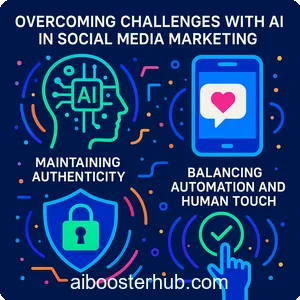
While AI offers numerous benefits, maintaining authenticity is a challenge. Over-reliance on AI tools in marketing can lead to content that feels robotic or disconnected from the brand’s voice. To address this, marketers should use AI as a tool to enhance creativity, not replace it. For example, AI-generated captions can be refined by human editors to ensure they align with the brand’s tone.
Data privacy and ethics
The use of AI-powered market research and AI in ads raises concerns about data privacy. Brands must ensure that their AI tools comply with regulations like GDPR and CCPA, transparently communicating how user data is collected and used. Ethical AI practices build trust with audiences, fostering long-term loyalty.
Balancing automation and human touch
While automation streamlines processes, human oversight remains essential. Marketers should regularly review AI-generated content and analytics to ensure they align with campaign goals. Combining AI’s efficiency with human creativity ensures that social media strategies remain authentic and impactful.
7. The future of AI in social media marketing
Emerging trends in AI
The future of AI in social media marketing is bright, with new advancements on the horizon. Emerging technologies, such as generative AI and natural language processing, will further enhance content creation and audience engagement. For example, AI could generate immersive video content or predict long-term trends with even greater accuracy.
Integration with emerging platforms
As new social media platforms emerge, AI advertising tools will play a crucial role in helping brands adapt. AI can analyze platform-specific trends and user behaviors, enabling marketers to create tailored strategies for each channel. This adaptability ensures that brands remain competitive in an ever-changing digital landscape.
Hyper-personalization
The demand for personalized experiences will continue to grow, and AI in ads will enable hyper-personalization. By leveraging advanced algorithms, brands can deliver content and ads tailored to individual users’ preferences, behaviors, and even emotions. This level of personalization will drive deeper engagement and brand loyalty.
8. Conclusion
AI in social media marketing is no longer a futuristic concept—it’s a reality that’s transforming how brands connect with audiences. From AI-powered market research to AI advertising tools, these technologies offer unparalleled opportunities to enhance engagement and optimize campaigns. By leveraging AI tools in marketing, brands can create personalized, data-driven strategies that resonate with audiences and drive results. As AI continues to evolve, its role in social media marketing will only grow, offering new ways to captivate and engage audiences in an increasingly competitive digital world.