AI Research Tools – Academic & Scientific Applications
The rise of artificial intelligence has transformed countless industries, and academic research is no exception. AI tools for research have become indispensable for researchers, students, and professionals seeking to streamline workflows, analyze complex data, and uncover new insights. From literature reviews to data analysis and manuscript preparation, AI tools for researchers offer innovative solutions to enhance productivity and precision.
This article explores the transformative role of AI research tools, their applications in academia and science, and how they empower researchers to push boundaries. Whether you’re a seasoned academic or a curious student, using AI for research can unlock new possibilities and redefine your approach to discovery.
1. Why AI tools are revolutionizing research
The integration of AI and research has reshaped how scholars approach their work. Traditional research methods, while effective, are often time-consuming and labor-intensive. AI tools for research address these challenges by automating repetitive tasks, providing deeper insights, and enabling researchers to focus on creativity and critical thinking. These tools leverage machine learning, natural language processing (NLP), and data analytics to process vast amounts of information quickly and accurately.
For instance, AI research tools can sift through thousands of academic papers in seconds, identifying relevant studies and summarizing key findings. They also assist with data visualization, predictive modeling, and even generating hypotheses based on patterns in existing data. By reducing manual effort, AI tools for researchers allow academics to allocate more time to designing experiments, interpreting results, and publishing their work.
The accessibility of AI tools for research has also democratized academia. Researchers from diverse fields—biology, sociology, engineering, and beyond—can now access sophisticated tools without needing advanced programming skills. This inclusivity fosters interdisciplinary collaboration and accelerates scientific progress.
Benefits of using AI for research
Using AI for research offers several advantages that enhance efficiency and output quality. These include:
- Speed and efficiency: AI can process and analyze data at a scale no human could match, saving hours or even days of work.
- Accuracy and precision: Advanced algorithms minimize errors in data analysis and literature reviews.
- Scalability: Whether working with small datasets or massive repositories, AI research tools can handle varying workloads.
- Insight generation: AI identifies patterns and correlations that might go unnoticed by human researchers.
- Multidisciplinary applications: From humanities to hard sciences, AI tools for researchers are versatile and adaptable.
The growing demand for AI in academia
The academic community has embraced AI tools for research due to their ability to address modern research challenges. With the exponential growth of published papers, staying current in any field is daunting. AI research tools simplify this by curating relevant literature and highlighting trends. Additionally, funding agencies and institutions increasingly expect researchers to leverage cutting-edge technologies to maximize impact, further driving the adoption of AI and research solutions.
2. Key types of AI tools for research
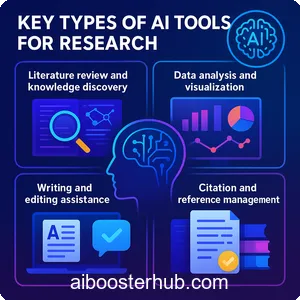
The landscape of AI tools for researchers is diverse, catering to various stages of the research process. Below, we explore the primary categories of AI research tools and their applications in academic and scientific settings.
Literature review and knowledge discovery
Conducting a literature review is a cornerstone of research, but it can be overwhelming due to the sheer volume of publications. AI tools for research like Semantic Scholar, Connected Papers, and Iris.ai streamline this process. These platforms use NLP to analyze abstracts, keywords, and citations, helping researchers identify relevant studies and uncover connections between papers.
For example, Semantic Scholar employs AI to rank papers based on relevance and impact, while Connected Papers creates visual maps of related studies. Iris.ai, on the other hand, uses concept-based search to explore interdisciplinary topics, making it ideal for researchers venturing into new fields. By using AI for research, scholars can build comprehensive literature reviews with minimal effort.
Data analysis and visualization
Data is the backbone of scientific research, and AI tools for researchers excel at processing and interpreting it. Tools like IBM Watson, Tableau with AI integrations, and Google’s AutoML enable researchers to analyze complex datasets, from genomic sequences to social survey responses. These platforms offer predictive modeling, anomaly detection, and automated statistical analysis, reducing the need for manual calculations.
Visualization is equally critical, as it helps communicate findings effectively. AI research tools like Plotly and Datawrapper generate dynamic charts and graphs, transforming raw data into compelling visuals. For researchers without advanced coding skills, these tools provide user-friendly interfaces to create publication-ready visualizations.
Writing and editing assistance
Crafting a clear, concise, and impactful research paper is no small feat. AI tools for research such as Grammarly, ProWritingAid, and Writefull enhance the writing process by offering grammar checks, style suggestions, and academic-specific language improvements. Writefull, for instance, is tailored for scientific writing, suggesting terminology and sentence structures commonly used in peer-reviewed journals.
Additionally, tools like Overleaf with AI integrations simplify LaTeX-based manuscript preparation, ensuring proper formatting for journal submissions. By using AI for research writing, researchers can polish their work and meet the rigorous standards of academic publishing.
Citation and reference management
Keeping track of citations is a tedious but essential task. AI tools for researchers like Zotero, Mendeley, and EndNote automate reference management by organizing sources, generating bibliographies, and ensuring compliance with citation styles (e.g., APA, MLA, Chicago). Some AI-enhanced versions even suggest additional references based on your manuscript’s content, ensuring a robust and well-supported bibliography.
Experiment design and simulation
For researchers in fields like physics, chemistry, or engineering, AI research tools offer powerful simulation capabilities. Tools like COMSOL Multiphysics and MATLAB with AI plugins allow researchers to model experiments, predict outcomes, and optimize parameters before conducting physical tests. These tools save time and resources by identifying potential pitfalls early in the research process.
Collaboration and project management
Research is often a collaborative endeavor, and AI tools for research facilitate seamless teamwork. Platforms like Notion AI and Trello with AI integrations help teams organize tasks, track progress, and share insights. Notion AI, for example, can summarize meeting notes or suggest action items, while Trello’s AI features prioritize tasks based on deadlines and project goals. These tools ensure that research projects stay on track, even across global teams.
3. How AI tools enhance scientific discovery
The true power of AI tools for researchers lies in their ability to accelerate scientific discovery. By automating routine tasks and uncovering hidden patterns, these tools enable breakthroughs that might otherwise take years to achieve.
Accelerating hypothesis generation
AI research tools can analyze existing data to propose new hypotheses. For instance, AlphaFold by DeepMind solved decades-old problems in protein folding by predicting molecular structures with unprecedented accuracy. Similarly, AI-driven platforms like IBM Watson for Drug Discovery analyze biological data to suggest novel drug targets, speeding up pharmaceutical research.
Handling big data
Modern research often involves massive datasets, from genomic sequences to climate models. AI tools for research excel at processing big data, identifying trends, and generating actionable insights. For example, tools like KNIME and RapidMiner offer drag-and-drop interfaces for building machine learning models, making big data analysis accessible to researchers without coding expertise.
Interdisciplinary research
AI and research go hand in hand in fostering interdisciplinary collaboration. Tools like Wolfram Alpha and Google Scholar’s AI-driven recommendations help researchers explore connections across fields, from physics to social sciences. This cross-pollination of ideas drives innovation and opens new avenues for discovery.
4. Challenges and considerations in using AI for research
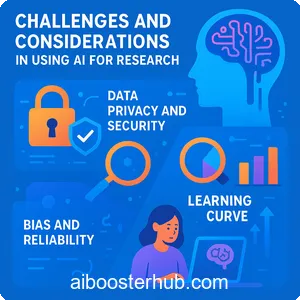
While AI tools for researchers offer immense benefits, they also come with challenges that must be addressed to ensure ethical and effective use.
Data privacy and security
Research often involves sensitive data, such as patient records or proprietary datasets. When using AI for research, researchers must ensure that tools comply with data protection regulations like GDPR or HIPAA. Cloud-based AI platforms should offer robust encryption and anonymization features to safeguard information.
Bias and reliability
AI systems are only as good as the data they’re trained on. Biased datasets can lead to skewed results, which is particularly concerning in fields like medicine or social sciences. Researchers must critically evaluate the outputs of AI research tools and cross-check findings with traditional methods to ensure reliability.
Learning curve
While many AI tools for research are user-friendly, some require a learning curve, especially for researchers unfamiliar with AI concepts. Training programs and tutorials can help bridge this gap, enabling broader adoption across academic institutions.
5. Real-world applications of AI research tools
The impact of AI tools for researchers is evident across various disciplines. Here are a few examples of how these tools are driving progress in academia and industry.
Medical and healthcare research
In healthcare, AI research tools are revolutionizing diagnostics, drug discovery, and personalized medicine. Tools like DeepMind’s AlphaFold and IBM Watson Health analyze biological data to uncover new treatment pathways. For instance, AI-driven imaging tools can detect early signs of diseases like cancer, improving patient outcomes.
Environmental and climate science
Climate researchers use AI tools for research to model complex systems, predict weather patterns, and optimize renewable energy solutions. Tools like Google Earth Engine and Climate AI process satellite imagery and environmental data to monitor deforestation, track carbon emissions, and develop sustainable strategies.
Social sciences and humanities
In fields like sociology and history, AI research tools analyze qualitative data, such as text archives or social media posts. Tools like NVivo and Voyant Tools use NLP to identify themes, sentiments, and cultural trends, providing deeper insights into human behavior and societal dynamics.
6. Choosing the right AI tools for your research
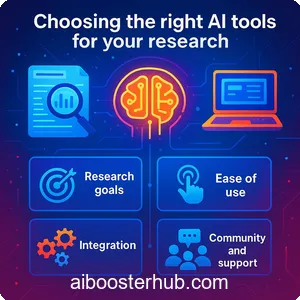
With so many AI tools for researchers available, selecting the right ones can be daunting. Here are some factors to consider:
- Research goals: Identify the specific tasks you need help with, such as data analysis, literature review, or writing.
- Ease of use: Choose tools with intuitive interfaces, especially if you lack technical expertise.
- Integration: Opt for tools that integrate with existing software, such as reference managers or data platforms.
- Community and support: Look for tools with active user communities and robust support resources, such as tutorials and forums.
- Scalability: Ensure the tool can handle your project’s data volume and complexity.
Popular platforms like ResearchGate and ORCID also integrate with AI research tools, allowing researchers to share findings and collaborate seamlessly.
7. The future of AI in research
The evolution of AI and research is just beginning. As AI technologies advance, we can expect even more sophisticated tools that anticipate researchers’ needs, automate entire workflows, and foster global collaboration. Emerging trends like generative AI, quantum computing, and explainable AI promise to further enhance the capabilities of AI tools for research.
For instance, generative AI could create draft manuscripts or suggest experimental designs, while quantum computing could solve complex simulations in seconds. Explainable AI will improve transparency, addressing concerns about bias and reliability. By staying informed about these developments, researchers can harness AI research tools to remain at the forefront of their fields.
8. Conclusion
AI tools for research are transforming the academic and scientific landscape, offering unprecedented opportunities to streamline workflows, uncover insights, and accelerate discovery. From literature reviews to data analysis and collaboration, these tools empower researchers to tackle complex challenges with confidence. By embracing AI and research, scholars can focus on what truly matters: advancing knowledge and solving real-world problems. Whether you’re exploring AI tools for researchers for the first time or integrating them into your workflow, the possibilities are endless. Start experimenting with these tools today and unlock the full potential of your research journey.