
Knowledge Distillation in Neural Networks: Complete Guide
Knowledge distillation has emerged as one of the most effective techniques for neural network compression, enabling developers to deploy powerful AI models on resource-constrained devices. This comprehensive guide explores how distilling the knowledge in a neural network can transform large, complex models into compact versions while preserving their predictive power.
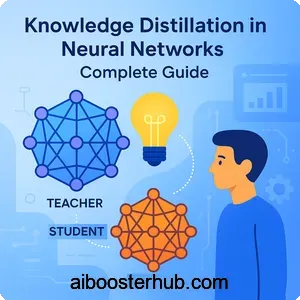
1. Understanding knowledge distillation
Knowledge distillation is a model compression technique that transfers knowledge from a large, complex neural network (the teacher) to a smaller, more efficient network (the student). This teacher-student learning paradigm allows us to capture the rich representations learned by deep neural networks and compress them into lightweight models suitable for deployment on mobile devices, edge computing platforms, or real-time applications.
The core insight behind model distillation is that the soft probability distributions produced by trained models contain more information than hard class labels. When a teacher model predicts probabilities like [0.05, 0.80, 0.10, 0.05] for four classes, it reveals relationships between classes that a simple one-hot encoded label [0, 1, 0, 0] would obscure. This “dark knowledge” embedded in the teacher’s outputs guides the student network to learn more effectively.
Why knowledge distillation matters
Traditional model compression techniques like pruning and quantization directly modify network architecture or parameters. Knowledge distillation takes a different approach by training a new model to mimic the behavior of a larger one. This method offers several advantages:
- Superior performance: Student models often outperform networks of similar size trained from scratch
- Flexibility: You can design student architectures independently of teacher models
- Ensemble compression: Multiple teacher models can be distilled into a single student
- Transfer across architectures: Knowledge can transfer between different network types
2. The mathematics of model distillation
The foundation of knowledge distillation lies in using the teacher model’s soft targets to train the student. Let’s examine the mathematical framework that makes this possible.
Softmax with temperature
Standard neural networks use softmax to convert logits \( z_i \) into probabilities:
$$ p_i = \frac{\exp(z_i)}{\sum_j \exp(z_j)} $$
Knowledge distillation introduces a temperature parameter \( T \) that controls the softness of probability distributions:
$$ p_i = \frac{\exp(z_i/T)}{\sum_j \exp(z_j/T)} $$
When \( T = 1 \), this is standard softmax. As \( T \) increases, the probability distribution becomes softer, revealing more about the relative similarities between classes. For example, with high temperature, the teacher might output [0.25, 0.40, 0.20, 0.15] instead of [0.01, 0.95, 0.03, 0.01], providing richer learning signals to the student.
The distillation loss function
The complete loss function for knowledge distillation combines two components:
$$ L_{total} = \alpha \cdot L_{distill}(p^T, p^S) + (1-\alpha) \cdot L_{CE}(y, p^S) $$
Where:
- \( L_{distill} \) measures the difference between teacher predictions \( p^T \) and student predictions \( p^S \)
- \( L_{CE} \) is the standard cross-entropy loss with true labels \( y \)
- \( \alpha \) balances the two objectives (typically 0.5-0.9)
The distillation loss typically uses Kullback-Leibler \(KL\) divergence:
$$ L_{distill} = T^2 \cdot KL(p^T || p^S) = T^2 \sum_i p_i^T \log\frac{p_i^T}{p_i^S} $$
The \( T^2 \) scaling factor compensates for the magnitude change when using higher temperatures. This ensures that gradients from the soft targets remain significant during training.
3. Implementing knowledge distillation in practice
Let’s build a complete knowledge distillation pipeline using Python and PyTorch. This example demonstrates how to distill a ResNet-34 teacher into a smaller ResNet-18 student for image classification.
Building the distillation framework
import torch
import torch.nn as nn
import torch.nn.functional as F
from torchvision import models, datasets, transforms

class DistillationLoss(nn.Module):
    """
    Combined loss for knowledge distillation
    """
    def __init__(self, temperature=3.0, alpha=0.7):
        super().__init__()
        self.temperature = temperature
        self.alpha = alpha
        self.ce_loss = nn.CrossEntropyLoss()

    def forward(self, student_logits, teacher_logits, labels):
        # Soft targets from teacher
        soft_targets = F.softmax(teacher_logits / self.temperature, dim=1)
        soft_predictions = F.log_softmax(student_logits / self.temperature, dim=1)

        # Distillation loss (KL divergence)
        distillation_loss = F.kl_div(
            soft_predictions,
            soft_targets,
            reduction='batchmean'
        ) * (self.temperature ** 2)

        # Standard cross-entropy loss with true labels
        student_loss = self.ce_loss(student_logits, labels)

        # Combined loss
        total_loss = (self.alpha * distillation_loss +
                     (1 - self.alpha) * student_loss)

        return total_loss

def train_with_distillation(teacher, student, train_loader,
                           optimizer, device, temperature=3.0, alpha=0.7):
    """
    Train student network using knowledge distillation
    """
    teacher.eval()  # Teacher in evaluation mode
    student.train()  # Student in training mode

    distillation_criterion = DistillationLoss(temperature, alpha)
    total_loss = 0
    correct = 0
    total = 0

    for batch_idx, (data, target) in enumerate(train_loader):
        data, target = data.to(device), target.to(device)

        optimizer.zero_grad()

        # Get predictions from both models
        with torch.no_grad():
            teacher_logits = teacher(data)

        student_logits = student(data)

        # Calculate distillation loss
        loss = distillation_criterion(student_logits, teacher_logits, target)

        loss.backward()
        optimizer.step()

        total_loss += loss.item()

        # Calculate accuracy
        _, predicted = student_logits.max(1)
        total += target.size(0)
        correct += predicted.eq(target).sum().item()

    avg_loss = total_loss / len(train_loader)
    accuracy = 100. * correct / total

    return avg_loss, accuracy

# Example usage
device = torch.device('cuda' if torch.cuda.is_available() else 'cpu')

# Initialize teacher and student models
teacher = models.resnet34(pretrained=True)
student = models.resnet18(pretrained=False)

# Prepare models
teacher = teacher.to(device)
student = student.to(device)

# Optimizer for student
optimizer = torch.optim.Adam(student.parameters(), lr=0.001)

# Training loop
for epoch in range(10):
    loss, acc = train_with_distillation(
        teacher, student, train_loader,
        optimizer, device, temperature=3.0, alpha=0.7
    )
    print(f'Epoch {epoch+1}: Loss={loss:.4f}, Accuracy={acc:.2f}%')
Advanced distillation techniques
Beyond the basic approach, several advanced variations of knowledge distillation have proven effective:
Feature-based distillation: Instead of matching only output probabilities, the student learns to mimic intermediate layer representations:
class FeatureDistillationLoss(nn.Module):
    def __init__(self, temperature=3.0, alpha=0.7, beta=0.5):
        super().__init__()
        self.temperature = temperature
        self.alpha = alpha
        self.beta = beta  # Weight for feature matching
        self.ce_loss = nn.CrossEntropyLoss()
        self.mse_loss = nn.MSELoss()

    def forward(self, student_output, teacher_output,
                student_features, teacher_features, labels):
        # Output distillation
        soft_targets = F.softmax(teacher_output / self.temperature, dim=1)
        soft_predictions = F.log_softmax(student_output / self.temperature, dim=1)
        distill_loss = F.kl_div(soft_predictions, soft_targets,
                                reduction='batchmean') * (self.temperature ** 2)

        # Feature matching
        feature_loss = self.mse_loss(student_features, teacher_features)

        # True label loss
        ce_loss = self.ce_loss(student_output, labels)

        total_loss = (self.alpha * distill_loss +
                     self.beta * feature_loss +
                     (1 - self.alpha - self.beta) * ce_loss)

        return total_loss
Attention transfer: This method transfers attention maps from teacher to student, helping the student focus on the same regions:
def attention_transfer_loss(teacher_attention, student_attention):
    """
    Calculate attention transfer loss between teacher and student
    """
    # Normalize attention maps
    teacher_attention = F.normalize(teacher_attention.pow(2).mean(1).view(
        teacher_attention.size(0), -1))
    student_attention = F.normalize(student_attention.pow(2).mean(1).view(
        student_attention.size(0), -1))

    # Calculate L2 distance
    loss = (teacher_attention - student_attention).pow(2).sum(1).mean()
    return loss
4. Neural network compression strategies
Knowledge distillation is one component of a broader toolkit for neural network compression. Understanding how it complements other techniques enables more effective model optimization.
Comparing compression approaches
Quantization reduces the precision of weights and activations from 32-bit floats to 8-bit integers or even lower. While this dramatically reduces model size and speeds up inference, it can hurt accuracy. Knowledge distillation can recover this lost accuracy by training quantized students with full-precision teachers.
Pruning removes unnecessary connections or entire neurons from networks. Structured pruning removes entire channels or layers, while unstructured pruning eliminates individual weights. Combining pruning with distillation often yields better results than pruning alone.
Architecture search designs efficient neural network architectures specifically for the task. When combined with distillation, these optimized architectures can learn from larger models, achieving excellent efficiency-accuracy trade-offs.
Distillation for different model types
The principles of model distillation extend beyond image classification to various deep learning domains:
Natural Language Processing: BERT models with hundreds of millions of parameters can be distilled into compact versions like DistilBERT, which retains 97% of performance with 40% fewer parameters:
from transformers import DistilBertConfig, DistilBertForSequenceClassification

# Initialize compact student model
student_config = DistilBertConfig(
    vocab_size=30522,
    n_layers=6,  # Half of BERT-base
    n_heads=12,
    dim=768
)
student_model = DistilBertForSequenceClassification(student_config)

# Distillation training follows similar principles
# with attention to token-level predictions
Object Detection: Large detection models like Faster R-CNN can be distilled to lightweight students:
def detection_distillation_loss(student_detections, teacher_detections,
                                gt_boxes, temperature=2.0):
    """
    Distillation loss for object detection
    Matches both classification and regression outputs
    """
    # Classification distillation
    cls_loss = F.kl_div(
        F.log_softmax(student_detections['logits'] / temperature, dim=1),
        F.softmax(teacher_detections['logits'] / temperature, dim=1),
        reduction='batchmean'
    ) * (temperature ** 2)

    # Bounding box regression matching
    box_loss = F.smooth_l1_loss(
        student_detections['boxes'],
        teacher_detections['boxes']
    )

    return cls_loss + box_loss
5. Optimizing the distillation process
Successful knowledge distillation requires careful tuning of hyperparameters and training procedures. Several factors significantly impact the quality of the distilled student model.
Temperature selection
The temperature parameter \( T \) is crucial for effective knowledge transfer. Lower temperatures (1-3) work well when the teacher is highly confident and accurate. Higher temperatures (4-10) help when transferring knowledge from ensembles or when the teacher has learned complex class relationships.
Empirically, a temperature around 3-4 works well for most image classification tasks. For fine-grained classification where class similarities matter, higher temperatures (5-7) often perform better:
def find_optimal_temperature(teacher, student, val_loader,
                            device, temperatures=[1, 2, 3, 4, 5, 6, 7]):
    """
    Empirically find the best temperature on validation set
    """
    best_temperature = 1
    best_accuracy = 0

    for temp in temperatures:
        student_copy = copy.deepcopy(student)
        optimizer = torch.optim.Adam(student_copy.parameters(), lr=0.001)

        # Train for a few epochs
        for _ in range(3):
            train_with_distillation(teacher, student_copy, train_loader,
                                   optimizer, device, temperature=temp)

        # Evaluate
        accuracy = evaluate(student_copy, val_loader, device)

        if accuracy > best_accuracy:
            best_accuracy = accuracy
            best_temperature = temp

    return best_temperature
Balancing loss components
The weight \( \alpha \) controls the balance between learning from the teacher (distillation) and learning from true labels (supervision). Starting with \( \alpha = 0.7 \) and adjusting based on validation performance typically works well.
When the teacher is very accurate, increase \( \alpha \) to 0.8-0.9. When the student architecture differs significantly from the teacher, decrease \( \alpha \) to 0.5-0.6 to allow more direct supervision.
Progressive distillation
For very large capacity gaps between teacher and student, progressive distillation through intermediate models can improve results:
def progressive_distillation(teachers, student, train_loader, device):
    """
    Distill through a sequence of intermediate models
    teachers: list of models from largest to smallest
    student: final compact model
    """
    current_student = student

    for i, teacher in enumerate(teachers):
        print(f"Distilling from teacher {i+1}/{len(teachers)}")

        optimizer = torch.optim.Adam(current_student.parameters(), lr=0.001)

        # Train current student with this teacher
        for epoch in range(10):
            loss, acc = train_with_distillation(
                teacher, current_student, train_loader,
                optimizer, device, temperature=3.0
            )

        # If not the final student, use this as teacher for next round
        if i < len(teachers) - 1:
            teacher = current_student
            current_student = create_next_smaller_model()

    return current_student
6. Real-world applications and case studies
Knowledge distillation has enabled numerous practical applications where computational constraints limit the use of large models.
Mobile deployment
Consider deploying an image classification app on smartphones. A ResNet-50 model achieves 95% accuracy but requires 98MB storage and 200ms inference time. Through distillation:
# Original teacher model
teacher = models.resnet50(pretrained=True)  # 98MB, 200ms inference

# Compact student through distillation
student = models.mobilenet_v2(pretrained=False)  # 14MB, 40ms inference

# After distillation training
distilled_accuracy = 93.8%  # Only 1.2% drop from teacher
The distilled MobileNet-v2 achieves 93.8% accuracy (just 1.2% below the teacher) while being 7x smaller and 5x faster. Without distillation, training MobileNet-v2 from scratch yields only 91.5% accuracy.
Edge computing
IoT devices often have severe memory and power constraints. A smart security camera needs real-time person detection but has only 4MB of available memory:
class TinyDetector(nn.Module):
    """Ultra-compact detector for edge devices"""
    def __init__(self):
        super().__init__()
        self.backbone = nn.Sequential(
            nn.Conv2d(3, 16, 3, stride=2, padding=1),
            nn.ReLU(),
            nn.Conv2d(16, 32, 3, stride=2, padding=1),
            nn.ReLU(),
            nn.Conv2d(32, 64, 3, stride=2, padding=1),
            nn.ReLU()
        )
        self.detector_head = nn.Conv2d(64, 5, 1)  # 4 bbox coords + confidence

    def forward(self, x):
        features = self.backbone(x)
        detections = self.detector_head(features)
        return detections

# Teacher: YOLOv5-m (21MB, 78% mAP)
# Student: TinyDetector (3.8MB, 68% mAP after distillation)
# Without distillation: TinyDetector achieves only 54% mAP
The distilled model runs at 30 FPS on a Raspberry Pi 4, enabling real-time detection in resource-constrained environments.
Ensemble compression
Multiple diverse models can be distilled into a single compact student, combining their strengths:
def ensemble_distillation(teachers, student, train_loader, optimizer, device):
    """
    Distill knowledge from an ensemble of teachers
    """
    for teacher in teachers:
        teacher.eval()

    student.train()

    for batch_idx, (data, target) in enumerate(train_loader):
        data, target = data.to(device), target.to(device)

        optimizer.zero_grad()

        # Average predictions from all teachers
        with torch.no_grad():
            teacher_logits_list = [teacher(data) for teacher in teachers]
            avg_teacher_logits = torch.stack(teacher_logits_list).mean(0)

        student_logits = student(data)

        # Distillation with ensemble average
        loss = distillation_loss(student_logits, avg_teacher_logits, target)
        loss.backward()
        optimizer.step()
An ensemble of ResNet-50, DenseNet-121, and EfficientNet-B0 (combined 310MB, 87.2% accuracy) distills into a single ResNet-18 (44MB, 86.1% accuracy). The student captures diverse knowledge from all three teachers.
7. Best practices and common pitfalls
Successfully implementing knowledge distillation requires attention to several important details and awareness of common mistakes.
Architectural considerations
Capacity gap: The student should have sufficient capacity to learn from the teacher. If the student is too small, it cannot capture the teacher’s knowledge regardless of training technique. As a rule of thumb, the student should have at least 20-30% of the teacher’s parameters.
Layer alignment: When using feature-based distillation, ensure teacher and student feature maps have compatible dimensions. Use 1×1 convolutions or pooling to match dimensions:
class FeatureAdapter(nn.Module):
    """Adapt student features to match teacher dimensions"""
    def __init__(self, student_dim, teacher_dim):
        super().__init__()
        self.adapter = nn.Conv2d(student_dim, teacher_dim, 1)

    def forward(self, student_features):
        return self.adapter(student_features)
Training strategies
Initialization: Initialize student networks with pre-trained weights when possible. A student pre-trained on ImageNet learns faster from distillation than random initialization.
Learning rate scheduling: Use a cosine annealing schedule or step decay. Start with a higher learning rate (0.01-0.1) for the first few epochs, then reduce gradually:
scheduler = torch.optim.lr_scheduler.CosineAnnealingLR(
    optimizer, T_max=100, eta_min=1e-5
)
Data augmentation: Apply the same augmentation to both teacher and student during distillation. This ensures they see consistent inputs and outputs.
Common mistakes to avoid
- Using temperature during inference: Apply temperature only during training. At test time, use \( T = 1 \) (standard softmax).
- Ignoring hard labels entirely: Always include some weight on the true label loss. Pure distillation \(( \alpha = 1 )\) often underperforms.
- Mismatched batch normalization: When the teacher uses batch normalization, ensure the student’s batch norm statistics are computed correctly during distillation.
- Insufficient training: Students typically need more epochs than training from scratch. Budget 1.5-2x the normal training time.
8. Knowledge Check
Quiz 1: Fundamentals of Knowledge Distillation
Quiz 2: The Role of Temperature
T within the softmax equation and its effect on the probability distribution.T is introduced into the softmax function to control the softness of the output probability distribution. When T is increased, the distribution becomes softer, assigning higher probabilities to less likely classes. This process reveals more information about the relative similarities between classes, providing richer learning signals for the student model.Quiz 3: The Distillation Loss Function
α?L_CE) and the distillation loss (L_distill). The cross-entropy loss trains the student on the hard, ground-truth labels, ensuring it learns to be factually correct. The distillation loss trains the student on the teacher’s soft targets, allowing it to learn the nuanced relationships and generalizations—the “dark knowledge”—captured by the teacher. The hyperparameter α balances these two competing objectives, controlling how much the student learns from the ground truth versus from the teacher’s generalized knowledge.Quiz 4: Advanced Distillation Methods
Quiz 5: Knowledge Distillation vs. Other Compression Methods
Quiz 6: Application in Natural Language Processing
Quiz 7: Practical Hyperparameter Tuning
T is identified as a crucial hyperparameter for effective knowledge transfer. For most image classification tasks, the recommended empirical range for T is between 3 and 4.Quiz 8: Real-World Performance Gains
Quiz 9: Ensemble Compression
Quiz 10: Common Pitfalls to Avoid
T must be set to 1 to produce standard softmax probabilities.