Generative Adversarial Networks (GAN): Complete Guide
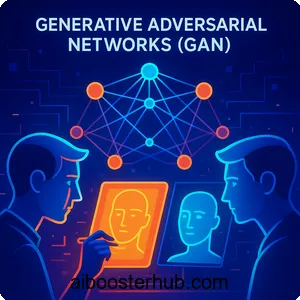
Imagine two artists locked in an eternal competition: one creating forgeries, the other detecting fakes. As they push each other to improve, both become masters of their craft. This is the essence of generative adversarial networks (GANs), one of the most revolutionary architectures in deep learning. Since their introduction, GANs have transformed how machines create realistic images, videos, music, and text, opening new frontiers in artificial intelligence.
In this comprehensive guide, we’ll explore what GANs are, how they work, their architecture, training process, and real-world applications that are reshaping industries.
1. What is a generative adversarial network?
A generative adversarial network (GAN) is a deep learning framework consisting of two neural networks—a generator and a discriminator—that compete against each other in a zero-sum game. The generator creates synthetic data attempting to mimic real data, while the discriminator tries to distinguish between real and generated samples. Through this adversarial training process, both networks improve continuously until the generator produces data indistinguishable from authentic samples.
The GAN model represents a paradigm shift in generative modeling. Unlike traditional approaches that explicitly model probability distributions, GANs learn to generate data through competition. This adversarial framework enables GANs to capture complex patterns in high-dimensional data, making them particularly effective for image synthesis, style transfer, and data augmentation.
The adversarial game theory
The relationship between generator and discriminator follows minimax game theory. The generator \( G \) aims to maximize the probability of fooling the discriminator, while the discriminator \( D \) seeks to maximize its classification accuracy. Mathematically, this is expressed as:
$$ \min_G \max_D V(D, G) =
\mathbb{E}_{x \sim p_{\text{data}}(x)}[\log D(x)] +
\mathbb{E}_{z \sim p_z(z)}[\log(1 – D(G(z)))] $$
Where \( x \) represents real data samples, \( z \) is random noise \(latent vector\), \( p_{data}(x) \) is the real data distribution, and \( p_z(z) \) is the noise distribution. The discriminator tries to maximize this value function by correctly classifying real samples as real (\( D(x) \) close to 1) and fake samples as fake (\( D(G(z)) \) close to 0). Conversely, the generator minimizes this by making \( D(G(z)) \) close to 1.
2. Understanding GAN architecture
The GAN architecture consists of two primary components that work in tandem: the generator network and the discriminator network. Each plays a distinct role in the adversarial learning process.
Generator network
The generator transforms random noise into synthetic data. It takes a latent vector \( z \) sampled from a simple distribution (typically Gaussian or uniform) and maps it to the data space through a series of learned transformations.
Here’s a basic generator implementation in Python using PyTorch:
import torch
import torch.nn as nn

class Generator(nn.Module):
    def __init__(self, latent_dim=100, img_shape=(1, 28, 28)):
        super(Generator, self).__init__()
        self.img_shape = img_shape

        def block(in_features, out_features, normalize=True):
            layers = [nn.Linear(in_features, out_features)]
            if normalize:
                layers.append(nn.BatchNorm1d(out_features))
            layers.append(nn.LeakyReLU(0.2, inplace=True))
            return layers

        self.model = nn.Sequential(
            *block(latent_dim, 128, normalize=False),
            *block(128, 256),
            *block(256, 512),
            *block(512, 1024),
            nn.Linear(1024, int(torch.prod(torch.tensor(img_shape)))),
            nn.Tanh()
        )

    def forward(self, z):
        img = self.model(z)
        img = img.view(img.size(0), *self.img_shape)
        return img
The generator progressively transforms low-dimensional noise into high-dimensional data through multiple layers. Batch normalization stabilizes training, while LeakyReLU activation functions help gradients flow during backpropagation. The final Tanh activation ensures outputs are in the range [-1, 1], matching normalized image data.
Discriminator network
The discriminator is a binary classifier that evaluates whether input samples are real or generated. It outputs a probability \( D(x) \) indicating the likelihood that input \( x \) comes from the real data distribution rather than the generator.
class Discriminator(nn.Module):
    def __init__(self, img_shape=(1, 28, 28)):
        super(Discriminator, self).__init__()

        self.model = nn.Sequential(
            nn.Linear(int(torch.prod(torch.tensor(img_shape))), 512),
            nn.LeakyReLU(0.2, inplace=True),
            nn.Linear(512, 256),
            nn.LeakyReLU(0.2, inplace=True),
            nn.Linear(256, 128),
            nn.LeakyReLU(0.2, inplace=True),
            nn.Linear(128, 1),
            nn.Sigmoid()
        )

    def forward(self, img):
        img_flat = img.view(img.size(0), -1)
        validity = self.model(img_flat)
        return validity
The discriminator uses a similar architecture but in reverse—compressing high-dimensional inputs into a single probability score. The sigmoid activation ensures outputs represent valid probabilities between 0 and 1.
Information flow in GAN architecture
The complete GAN architecture involves three key phases during training:
- Discriminator training: Real samples receive label 1, generated samples receive label 0. The discriminator updates its weights to minimize classification error.
- Generator training: The generator creates samples and receives gradients based on how well it fooled the discriminator. It updates weights to maximize ( D(G(z)) ).
- Equilibrium: Ideally, training reaches Nash equilibrium where the generator produces perfect fakes and the discriminator guesses randomly with 50% accuracy.
3. The adversarial training process
Training GANs involves alternating between discriminator and generator optimization. This adversarial training process requires careful balancing to ensure both networks improve synchronously.
Training algorithm
The standard GAN training algorithm follows these steps:
import torch.optim as optim

# Initialize networks
generator = Generator(latent_dim=100)
discriminator = Discriminator()

# Loss function
adversarial_loss = nn.BCELoss()

# Optimizers
optimizer_G = optim.Adam(generator.parameters(), lr=0.0002, betas=(0.5, 0.999))
optimizer_D = optim.Adam(discriminator.parameters(), lr=0.0002, betas=(0.5, 0.999))

# Training loop
for epoch in range(num_epochs):
    for i, real_imgs in enumerate(dataloader):
        batch_size = real_imgs.size(0)

        # Adversarial ground truths
        valid = torch.ones(batch_size, 1)
        fake = torch.zeros(batch_size, 1)

        # ---------------------
        #  Train Discriminator
        # ---------------------
        optimizer_D.zero_grad()

        # Loss on real images
        real_loss = adversarial_loss(discriminator(real_imgs), valid)

        # Loss on fake images
        z = torch.randn(batch_size, latent_dim)
        gen_imgs = generator(z)
        fake_loss = adversarial_loss(discriminator(gen_imgs.detach()), fake)

        # Total discriminator loss
        d_loss = (real_loss + fake_loss) / 2
        d_loss.backward()
        optimizer_D.step()

        # -----------------
        #  Train Generator
        # -----------------
        optimizer_G.zero_grad()

        # Generate images and calculate loss
        gen_imgs = generator(z)
        g_loss = adversarial_loss(discriminator(gen_imgs), valid)

        g_loss.backward()
        optimizer_G.step()
Training challenges and solutions
GAN training is notoriously unstable. Several common issues arise:
Mode collapse: The generator produces limited varieties of samples, failing to capture the full data distribution. This occurs when the generator finds a few samples that consistently fool the discriminator and stops exploring other possibilities. Solutions include minibatch discrimination, unrolled GANs, and using different loss functions.
Vanishing gradients: When the discriminator becomes too powerful, it provides no useful gradient information to the generator. The gradient of \( \log(1-D(G(z))) \) saturates when \( D(G(z)) \) approaches 0. A practical modification uses \( -\log(D(G(z))) \) instead, providing stronger gradients in early training.
Convergence difficulties: GANs may oscillate without reaching equilibrium. The discriminator and generator might overpower each other alternately, preventing stable convergence. Techniques like learning rate scheduling, gradient penalty, and spectral normalization help stabilize training.
Loss functions and variants
While the original GAN uses binary cross-entropy loss, several variants improve training stability:
Wasserstein GAN (WGAN) replaces the discriminator with a critic that estimates Wasserstein distance:
$$ L = \mathbb{E}{x \sim p{data}}[D(x)] – \mathbb{E}_{z \sim p_z}[D(G(z))] $$
This provides more meaningful gradients and reduces mode collapse. WGAN-GP adds gradient penalty for further stabilization.
Least Squares GAN (LSGAN) uses mean squared error instead of cross-entropy, pushing generated samples toward the decision boundary rather than just crossing it.
4. Advanced GAN architectures
The basic GAN framework has evolved into numerous sophisticated variants, each addressing specific limitations or targeting particular applications.
Deep Convolutional GAN (DCGAN)
DCGAN revolutionized image generation by incorporating convolutional neural networks with architectural guidelines that stabilize training:
- Replace pooling layers with strided convolutions (discriminator) and fractional-strided convolutions (generator)
- Use batch normalization in both networks except the generator output and discriminator input layers
- Remove fully connected hidden layers
- Use ReLU activation in the generator (except output layer with Tanh) and LeakyReLU in the discriminator
class DCGANGenerator(nn.Module):
    def __init__(self, latent_dim=100, channels=3):
        super(DCGANGenerator, self).__init__()

        self.init_size = 4
        self.l1 = nn.Sequential(nn.Linear(latent_dim, 512 * self.init_size ** 2))

        self.conv_blocks = nn.Sequential(
            nn.BatchNorm2d(512),
            nn.Upsample(scale_factor=2),
            nn.Conv2d(512, 256, 3, stride=1, padding=1),
            nn.BatchNorm2d(256),
            nn.ReLU(inplace=True),
            nn.Upsample(scale_factor=2),
            nn.Conv2d(256, 128, 3, stride=1, padding=1),
            nn.BatchNorm2d(128),
            nn.ReLU(inplace=True),
            nn.Upsample(scale_factor=2),
            nn.Conv2d(128, 64, 3, stride=1, padding=1),
            nn.BatchNorm2d(64),
            nn.ReLU(inplace=True),
            nn.Conv2d(64, channels, 3, stride=1, padding=1),
            nn.Tanh()
        )

    def forward(self, z):
        out = self.l1(z)
        out = out.view(out.shape[0], 512, self.init_size, self.init_size)
        img = self.conv_blocks(out)
        return img
DCGAN generates high-quality images and enables smooth interpolation in latent space, demonstrating that GANs learn meaningful representations.
Conditional GAN (cGAN)
Conditional GANs extend the basic framework by conditioning generation on additional information (labels, attributes, or other data). Both generator and discriminator receive conditional information as input:
$$\min_G \max_D V(D, G) =
\mathbb{E}_{x \sim p_{\text{data}}(x)}[\log D(x \mid y)] +
\mathbb{E}_{z \sim p_z(z)}[\log(1 – D(G(z \mid y)))]$$
Where \( y \) represents conditional information. This enables controlled generation—for example, specifying digit class when generating handwritten numbers, or providing text descriptions for image synthesis.
StyleGAN
StyleGAN introduces style-based generation, allowing fine-grained control over image attributes at different scales. It uses adaptive instance normalization (AdaIN) to inject style information at each resolution level, separating high-level attributes (pose, identity) from low-level details (color scheme, microstructure).
Key innovations include:
- Mapping network transforming latent codes into an intermediate latent space
- Synthesis network with AdaIN operations at each layer
- Stochastic variation through noise injection
- Progressive growing for high-resolution generation
StyleGAN produces photorealistic faces and enables intuitive manipulation through style mixing and latent space interpolation.
CycleGAN
CycleGAN performs unpaired image-to-image translation without requiring paired training examples. It uses two generators (G: X→Y and F: Y→X) and two discriminators, enforcing cycle consistency:
$$L_{\text{cyc}}(G, F) =
\mathbb{E}_{x \sim p_{\text{data}}(x)}\left[ \| F(G(x)) – x \|_1 \right] +
\mathbb{E}_{y \sim p_{\text{data}}(y)}\left[ \| G(F(y)) – y \|_1 \right] $$
This architecture enables applications like converting horses to zebras, summer to winter scenes, or photos to paintings—all without paired datasets.
5. Practical applications of GANs
GANs have transcended research laboratories to power real-world applications across diverse domains.
Image synthesis and enhancement
GANs excel at generating photorealistic images. StyleGAN and its successors create convincing human faces, artwork, and scenes. Super-resolution GANs (SRGAN) enhance low-resolution images by learning to add realistic details, improving medical imaging, satellite imagery, and old photograph restoration.
Data augmentation
In machine learning, insufficient training data limits model performance. GANs generate synthetic training samples, particularly valuable for imbalanced datasets. Medical imaging benefits significantly—generating rare pathology examples helps train diagnostic systems without compromising patient privacy.
Style transfer and artistic creation
GANs enable artistic applications like neural style transfer, converting photographs into paintings mimicking famous artists. CycleGAN transforms photos into various artistic styles. Some GANs generate entirely new artworks, music compositions, and creative designs, sparking debates about AI creativity.
Text-to-image synthesis
Modern GANs combine with natural language processing to generate images from text descriptions. Models like DALL-E predecessors use conditional GANs to interpret textual prompts and create corresponding visuals, revolutionizing creative workflows, advertising, and content creation.
Video generation and deepfakes
GANs generate realistic video content, including face reenactment and video synthesis. While this technology enables beneficial applications like film production and virtual avatars, it also raises concerns about deepfakes—synthetic media potentially used for misinformation. Understanding GAN capabilities helps develop detection methods and ethical guidelines.
Drug discovery and molecular generation
In pharmaceutical research, GANs generate novel molecular structures with desired properties. By training on existing compounds, GANs explore chemical space efficiently, accelerating drug discovery and materials science research.
6. Challenges and future directions
Despite remarkable success, GAN deep learning faces persistent challenges that drive ongoing research.
Training stability
Achieving stable GAN training remains difficult. The adversarial setup creates a non-cooperative game where standard optimization techniques struggle. Research continues exploring alternative training procedures, regularization methods, and architectural modifications. Techniques like spectral normalization, self-attention mechanisms, and two-timescale update rules improve stability but haven’t completely solved the problem.
Evaluation metrics
Measuring GAN performance objectively is challenging. Traditional metrics like likelihood are intractable for implicit generative models. Researchers use alternatives like Inception Score (IS) and Fréchet Inception Distance (FID), but these have limitations and may not capture all aspects of generation quality. Developing comprehensive evaluation frameworks remains an active research area.
Computational requirements
Training high-quality GANs demands substantial computational resources. Generating high-resolution images requires powerful GPUs and extended training times, limiting accessibility. Efficient architectures and training strategies are being developed to democratize GAN technology.
Ethical considerations
As GANs become more powerful, ethical concerns intensify. Deepfakes pose threats to privacy, security, and information integrity. Generated content might infringe copyrights or perpetuate biases present in training data. The AI community must develop responsible practices, detection methods, and regulations governing GAN usage.
Emerging research directions
Current research explores several promising directions:
- Diffusion models: Alternative generative approaches showing superior sample quality and training stability
- Few-shot learning: Enabling GANs to generalize from limited examples
- Cross-modal generation: Bridging different data modalities (text, image, audio, video)
- Interpretability: Understanding what GANs learn and how they represent data internally
- Efficiency: Reducing computational costs through knowledge distillation, pruning, and architecture search
7. Getting started with GANs
Building your first GAN requires understanding both theoretical foundations and practical implementation details.
Implementation tips
Start with simple datasets like MNIST before tackling complex images. Monitor both generator and discriminator losses—if one dominates consistently, adjust learning rates or architecture. Visualize generated samples regularly to detect mode collapse early. Use pre-trained models and established architectures (DCGAN, StyleGAN) as starting points.
Recommended resources
Numerous libraries simplify GAN implementation. PyTorch and TensorFlow provide flexible frameworks. Libraries like PyTorch-GAN offer ready-made implementations of popular architectures. Online courses, tutorials, and research papers provide deeper insights into GAN theory and practice.
Experimentation framework
# Complete training script structure
def train_gan(generator, discriminator, dataloader, num_epochs):
    for epoch in range(num_epochs):
        for batch_idx, (real_data, _) in enumerate(dataloader):
            # Train discriminator
            d_loss = train_discriminator(real_data, generator, discriminator)

            # Train generator
            g_loss = train_generator(generator, discriminator)

            # Log progress
            if batch_idx % 100 == 0:
                print(f"Epoch [{epoch}/{num_epochs}] Batch {batch_idx}")
                print(f"D Loss: {d_loss:.4f} | G Loss: {g_loss:.4f}")

                # Save generated samples
                with torch.no_grad():
                    z = torch.randn(16, latent_dim)
                    fake_imgs = generator(z)
                    save_image(fake_imgs, f'samples/epoch_{epoch}_batch_{batch_idx}.png')

        # Save model checkpoints
        torch.save(generator.state_dict(), f'checkpoints/generator_epoch_{epoch}.pth')
        torch.save(discriminator.state_dict(), f'checkpoints/discriminator_epoch_{epoch}.pth')
8. Knowledge Check
Quiz 1: Understanding GAN fundamentals
Question: What are the two main components of a generative adversarial network, and how do they interact during the training process?
Answer: A GAN consists of two neural networks: the generator and the discriminator. The generator creates synthetic data attempting to mimic real data, while the discriminator tries to distinguish between real and generated samples. They compete in an adversarial game where both networks improve continuously through this competition.
Quiz 2: The adversarial game
Question: Explain the minimax objective function in GANs and what each network is trying to optimize.
Answer: The GAN uses a minimax game where the discriminator tries to maximize its ability to correctly classify real and fake samples, while the generator tries to minimize the discriminator’s ability to detect fakes. Mathematically, the discriminator maximizes the value function while the generator minimizes it, creating an adversarial dynamic.
Quiz 3: Generator architecture
Question: What is the role of the generator network in a GAN, and what type of input does it take to produce outputs?
Answer: The generator transforms random noise (latent vectors) sampled from a simple distribution like Gaussian into synthetic data. It takes a low-dimensional noise vector and maps it to the high-dimensional data space through learned transformations, progressively creating realistic outputs.
Quiz 4: Discriminator function
Question: How does the discriminator network evaluate samples, and what does its output represent?
Answer: The discriminator is a binary classifier that evaluates whether input samples are real or generated. It outputs a probability indicating the likelihood that an input comes from the real data distribution rather than the generator, with values ranging from 0 (fake) to 1 (real).
Quiz 5: Training challenges
Question: What is mode collapse in GAN training, and why is it problematic?
Answer: Mode collapse occurs when the generator produces only limited varieties of samples, failing to capture the full data distribution. This happens when the generator finds a few samples that consistently fool the discriminator and stops exploring other possibilities, resulting in lack of diversity in generated outputs.
Quiz 6: DCGAN innovations
Question: What architectural guidelines does Deep Convolutional GAN (DCGAN) introduce to stabilize training?
Answer: DCGAN uses strided convolutions instead of pooling, applies batch normalization in both networks (except specific layers), removes fully connected hidden layers, and uses ReLU activation in the generator and LeakyReLU in the discriminator. These guidelines significantly improve training stability for image generation.
Quiz 7: Conditional GAN
Question: How does a conditional GAN differ from a standard GAN, and what advantage does this provide?
Answer: A conditional GAN extends the basic framework by conditioning generation on additional information like labels or attributes. Both generator and discriminator receive this conditional information as input, enabling controlled generation where users can specify desired attributes of the output.
Quiz 8: CycleGAN application
Question: What unique capability does CycleGAN provide, and how does it achieve this without paired training data?
Answer: CycleGAN performs unpaired image-to-image translation without requiring paired examples. It uses two generators and two discriminators with cycle consistency loss, ensuring that translating from domain X to Y and back to X recovers the original image, enabling transformations like horses to zebras.
Quiz 9: Nash equilibrium
Question: What is the ideal training outcome for a GAN, and what happens at Nash equilibrium?
Answer: The ideal outcome is reaching Nash equilibrium where the generator produces perfect fakes that are indistinguishable from real data, and the discriminator can only guess randomly with 50% accuracy. At this point, neither network can improve further given the other’s strategy.
Quiz 10: Practical applications
Question: Describe three real-world applications where GANs are currently making significant impact.
Answer: GANs are used for: (1) Image synthesis and super-resolution, creating photorealistic faces and enhancing low-resolution images; (2) Data augmentation, generating synthetic training samples for imbalanced datasets especially in medical imaging; (3) Style transfer and artistic creation, converting photographs into various artistic styles and generating new creative content.