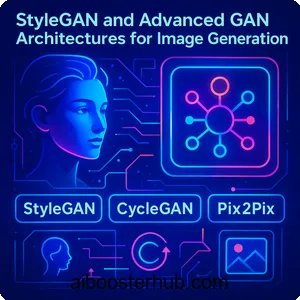
StyleGAN and Advanced GAN Architectures for Image Generation
Generative adversarial networks have revolutionized the field of image synthesis, enabling machines to create photorealistic images that are virtually indistinguishable from real photographs. Among the most impressive developments in this space are StyleGAN, CycleGAN, and Pix2Pix—architectures that have pushed the boundaries of what’s possible in image generation and transformation. This article explores these advanced GAN architectures, their underlying mechanisms, and their practical applications in modern AI systems.
1. Understanding the foundations of generative adversarial networks
Before diving into advanced architectures, it’s essential to understand how generative adversarial networks operate. A GAN consists of two neural networks that compete against each other: a generator that creates synthetic images and a discriminator that attempts to distinguish between real and generated images.
The training process follows a minimax game where the generator tries to fool the discriminator, while the discriminator improves its ability to detect fake images. Mathematically, this can be expressed as:
$$ \min_G \max_D V(D, G) =
\mathbb{E}_{x \sim p_{\text{data}}(x)}[\log D(x)] +
\mathbb{E}_{z \sim p_z(z)}[\log(1 – D(G(z)))] $$
The generator \( G \) takes random noise \( z \) as input and produces synthetic images, while the discriminator \( D \) outputs a probability indicating whether an image is real or fake. This adversarial training process continues until the generator produces images convincing enough to fool the discriminator.
The limitations of traditional GAN approaches
Early GAN implementations faced several challenges that limited their practical applications. Training instability often caused mode collapse, where the generator would produce only a limited variety of outputs. Additionally, traditional GANs offered minimal control over the attributes of generated images, making it difficult to manipulate specific features like facial expressions or lighting conditions.
These limitations motivated researchers to develop more sophisticated architectures that could generate higher-quality images while providing better control over the generation process. This led to the development of StyleGAN and other specialized GAN architectures designed for specific tasks.
2. StyleGAN: Revolutionizing controllable image synthesis
StyleGAN introduced a paradigm shift in how we approach image generation by incorporating style-based generation techniques borrowed from neural style transfer. Developed by NVIDIA researchers, StyleGAN enables unprecedented control over generated images through its innovative architecture.
The architecture of StyleGAN
Unlike traditional GANs that feed latent vectors directly into the generator, StyleGAN uses a mapping network to transform the input latent code \( z \) into an intermediate latent space \( w \). This intermediate representation is then injected into different layers of the synthesis network through adaptive instance normalization (AdaIN).
The mapping network consists of several fully connected layers:
$$ w = f(z), \quad z \sim \mathcal{N}(0, I) $$
where \( f \) represents the mapping function. The synthesis network then generates images progressively, with style information injected at multiple resolutions. At each layer, the AdaIN operation modifies the feature maps based on the style vector:
$$ \text{AdaIN}(x_i, y) = y_{s,i} \frac{x_i – \mu(x_i)}{\sigma(x_i)} + y_{b,i} $$
Here, \( x_i \) represents the feature maps at layer \( i \), while \( y_{s,i} \) and \( y_{b,i} \) are the scale and bias parameters derived from the style vector \( w \).
Style mixing and disentanglement
One of StyleGAN’s most powerful features is style mixing, which allows combining styles from different source images. By using different \( w \) vectors at different layers, we can control coarse features like pose and face shape at lower resolutions, while fine details like hair texture and color are controlled at higher resolutions.
Here’s a practical implementation of StyleGAN’s style mixing concept:
import torch
import torch.nn as nn

class StyleMixingGenerator(nn.Module):
    def __init__(self, latent_dim=512, style_dim=512):
        super().__init__()
        self.mapping_network = MappingNetwork(latent_dim, style_dim)
        self.synthesis_network = SynthesisNetwork(style_dim)

    def forward(self, z1, z2, mixing_layer=4):
        # Map latent codes to style vectors
        w1 = self.mapping_network(z1)
        w2 = self.mapping_network(z2)

        # Create mixed style vector
        styles = []
        for layer_idx in range(self.synthesis_network.num_layers):
            if layer_idx < mixing_layer:
                styles.append(w1)
            else:
                styles.append(w2)

        # Generate image with mixed styles
        image = self.synthesis_network(styles)
        return image

class MappingNetwork(nn.Module):
    def __init__(self, latent_dim, style_dim, num_layers=8):
        super().__init__()
        layers = []
        for i in range(num_layers):
            layers.extend([
                nn.Linear(latent_dim if i == 0 else style_dim, style_dim),
                nn.LeakyReLU(0.2)
            ])
        self.network = nn.Sequential(*layers)

    def forward(self, z):
        return self.network(z)
This architecture allows for fine-grained control over different aspects of the generated image. For example, in face generation, early layers control overall structure and pose, middle layers affect facial features and expressions, and later layers determine fine details like skin texture and hair.
Progressive growing and resolution control
StyleGAN builds images progressively, starting from low resolution and gradually increasing detail. This approach stabilizes training and produces high-quality results at resolutions up to 1024×1024 pixels or higher. Each resolution level focuses on adding specific types of details, creating a hierarchical generation process.
3. StyleGAN2 and StyleGAN3: Iterative improvements
Building on the original StyleGAN’s success, StyleGAN2 addressed several artifacts and quality issues present in the first version. The main improvements focused on removing characteristic blob-like artifacts and improving image quality through architectural modifications.
Key improvements in StyleGAN2
StyleGAN2 introduced weight demodulation to replace adaptive instance normalization, which eliminated the characteristic artifacts of the original StyleGAN. The weight demodulation operation is defined as:
$$ w’_{ijk} = \frac{w_{ijk}}{\sqrt{\sum_{i,k} w_{ijk}^2 + \epsilon}} $$
where \( w_{ijk} \) represents the convolutional weights. This modification ensures that the expected statistics of the convolution outputs remain consistent regardless of the input style.
StyleGAN2 also redesigned the generator architecture by removing progressive growing and implementing a residual architecture with skip connections. This change improved training stability and output quality without sacrificing the benefits of multi-scale generation.
class StyleGAN2Generator(nn.Module):
    def __init__(self, latent_dim=512, style_dim=512):
        super().__init__()
        self.mapping = MappingNetwork(latent_dim, style_dim)
        self.synthesis = ModulatedSynthesisNetwork(style_dim)
        self.constant_input = nn.Parameter(torch.randn(1, 512, 4, 4))

    def forward(self, z, truncation_psi=0.7):
        w = self.mapping(z)

        # Truncation trick for better quality
        if truncation_psi < 1:
            w_mean = self.mapping.w_mean
            w = w_mean + truncation_psi * (w - w_mean)

        image = self.synthesis(self.constant_input, w)
        return image

class ModulatedConv2d(nn.Module):
    def __init__(self, in_channels, out_channels, kernel_size, style_dim):
        super().__init__()
        self.weight = nn.Parameter(
            torch.randn(out_channels, in_channels, kernel_size, kernel_size)
        )
        self.style_transform = nn.Linear(style_dim, in_channels)
        self.demodulate = True

    def forward(self, x, style):
        batch, in_c, height, width = x.shape

        # Modulate weights
        style = self.style_transform(style).view(batch, 1, in_c, 1, 1)
        weight = self.weight.unsqueeze(0) * style

        # Demodulate
        if self.demodulate:
            demod = torch.rsqrt(weight.pow(2).sum([2, 3, 4]) + 1e-8)
            weight = weight * demod.view(batch, -1, 1, 1, 1)

        # Reshape and convolve
        weight = weight.view(batch * self.weight.shape[0], *self.weight.shape[1:])
        x = x.view(1, batch * in_c, height, width)
        out = torch.conv2d(x, weight, padding=1, groups=batch)

        return out.view(batch, -1, height, width)
StyleGAN3: Addressing texture sticking and equivariance
StyleGAN3 tackled a subtle but important issue: texture sticking, where fine details appear to adhere to pixel coordinates rather than moving naturally with the underlying structure. This problem became apparent when generating animations or transformations.
StyleGAN3 achieves translation and rotation equivariance through careful architectural design, ensuring that transformations in the latent space correspond to natural transformations in the generated images. The architecture replaces traditional upsampling and downsampling operations with continuous signal processing techniques, treating images as continuous signals rather than discrete pixel grids.
4. Image-to-image translation with Pix2Pix
While StyleGAN focuses on generating images from random noise, Pix2Pix addresses a different challenge: translating images from one domain to another while preserving structural information. This supervised learning approach requires paired training examples but achieves impressive results in various image-to-image translation tasks.
The Pix2Pix architecture
Pix2Pix uses a conditional GAN framework where both the generator and discriminator receive the input image as conditioning information. The generator follows a U-Net architecture with skip connections that help preserve spatial information:
The objective function combines the adversarial loss with an L1 reconstruction loss:
$$ \mathcal{L}_{\text{Pix2Pix}}(G, D) =
\mathcal{L}_{\text{cGAN}}(G, D) +
\lambda\, \mathcal{L}_{L1}(G) $$
where the conditional GAN loss is:
$$ \mathcal{L}_{\text{cGAN}}(G, D) =
\mathbb{E}_{x, y}[\log D(x, y)] +
\mathbb{E}_{x, z}[\log(1 – D(x, G(x, z)))]$$
and the L1 loss is:
$$ \mathcal{L}_{L1}(G) = \mathbb{E}_{x, y, z}\left[ \| y – G(x, z) \|_1 \right] $$
Here, \( x \) represents the input image, \( y \) is the target output, and \( z \) is random noise.
Practical implementation of Pix2Pix
import torch
import torch.nn as nn

class UNetGenerator(nn.Module):
    def __init__(self, in_channels=3, out_channels=3):
        super().__init__()

        # Encoder
        self.down1 = self.down_block(in_channels, 64, normalize=False)
        self.down2 = self.down_block(64, 128)
        self.down3 = self.down_block(128, 256)
        self.down4 = self.down_block(256, 512)
        self.down5 = self.down_block(512, 512)

        # Decoder with skip connections
        self.up1 = self.up_block(512, 512, dropout=True)
        self.up2 = self.up_block(1024, 256, dropout=True)
        self.up3 = self.up_block(512, 128)
        self.up4 = self.up_block(256, 64)

        self.final = nn.Sequential(
            nn.ConvTranspose2d(128, out_channels, 4, 2, 1),
            nn.Tanh()
        )

    def down_block(self, in_c, out_c, normalize=True):
        layers = [nn.Conv2d(in_c, out_c, 4, 2, 1)]
        if normalize:
            layers.append(nn.BatchNorm2d(out_c))
        layers.append(nn.LeakyReLU(0.2))
        return nn.Sequential(*layers)

    def up_block(self, in_c, out_c, dropout=False):
        layers = [
            nn.ConvTranspose2d(in_c, out_c, 4, 2, 1),
            nn.BatchNorm2d(out_c),
            nn.ReLU()
        ]
        if dropout:
            layers.append(nn.Dropout(0.5))
        return nn.Sequential(*layers)

    def forward(self, x):
        # Encoder
        d1 = self.down1(x)
        d2 = self.down2(d1)
        d3 = self.down3(d2)
        d4 = self.down4(d3)
        d5 = self.down5(d4)

        # Decoder with skip connections
        u1 = self.up1(d5)
        u2 = self.up2(torch.cat([u1, d4], 1))
        u3 = self.up3(torch.cat([u2, d3], 1))
        u4 = self.up4(torch.cat([u3, d2], 1))

        return self.final(torch.cat([u4, d1], 1))

class PatchGANDiscriminator(nn.Module):
    def __init__(self, in_channels=6):
        super().__init__()

        self.model = nn.Sequential(
            nn.Conv2d(in_channels, 64, 4, 2, 1),
            nn.LeakyReLU(0.2),
            nn.Conv2d(64, 128, 4, 2, 1),
            nn.BatchNorm2d(128),
            nn.LeakyReLU(0.2),
            nn.Conv2d(128, 256, 4, 2, 1),
            nn.BatchNorm2d(256),
            nn.LeakyReLU(0.2),
            nn.Conv2d(256, 512, 4, 1, 1),
            nn.BatchNorm2d(512),
            nn.LeakyReLU(0.2),
            nn.Conv2d(512, 1, 4, 1, 1)
        )

    def forward(self, x, y):
        return self.model(torch.cat([x, y], 1))
The PatchGAN discriminator evaluates the image at the patch level rather than classifying the entire image, which helps preserve high-frequency details and textures. This design choice makes Pix2Pix particularly effective for tasks requiring sharp, detailed outputs.
Applications of Pix2Pix
Pix2Pix excels in numerous image-to-image translation tasks. In architectural visualization, it can convert rough sketches into photorealistic renderings. For map generation, it translates satellite imagery into street maps or vice versa. The model has also been successfully applied to colorizing black-and-white photos, converting day scenes to night, and transforming semantic segmentation masks into realistic images.
5. CycleGAN: Unpaired image-to-image translation
While Pix2Pix requires paired training examples, CycleGAN removes this constraint by learning to translate between domains using unpaired images. This breakthrough enables applications where paired data is difficult or impossible to obtain.
The cycle consistency principle
CycleGAN introduces cycle consistency loss to ensure that an image translated from domain A to domain B can be translated back to reconstruct the original image. This creates a self-supervised learning signal without requiring paired examples.
The full objective function consists of adversarial losses for both directions and cycle consistency losses:
$$\mathcal{L}(G, F, D_X, D_Y) =
\mathcal{L}_{\text{GAN}}(G, D_Y, X, Y) +
\mathcal{L}_{\text{GAN}}(F, D_X, Y, X) +
\lambda\, \mathcal{L}_{\text{cyc}}(G, F)$$
where the cycle consistency loss is defined as:
$$\mathcal{L}_{\text{cyc}}(G, F) =
\mathbb{E}_{x \sim p_{\text{data}}(x)}\!\left[ \| F(G(x)) – x \|_1 \right] +
\mathbb{E}_{y \sim p_{\text{data}}(y)}\!\left[ \| G(F(y)) – y \|_1 \right] $$
Here, \( G \) translates from domain X to domain Y, \( F \) translates from Y to X, and the cycle consistency ensures \( F(G(x)) \approx x \) and \( G(F(y)) \approx y \).
Implementing CycleGAN
class CycleGAN(nn.Module):
    def __init__(self):
        super().__init__()
        self.G_AB = Generator()  # A to B
        self.G_BA = Generator()  # B to A
        self.D_A = Discriminator()
        self.D_B = Discriminator()

        self.criterion_GAN = nn.MSELoss()
        self.criterion_cycle = nn.L1Loss()
        self.criterion_identity = nn.L1Loss()

    def forward(self, real_A, real_B, lambda_cycle=10.0, lambda_identity=5.0):
        # Generate fake images
        fake_B = self.G_AB(real_A)
        fake_A = self.G_BA(real_B)

        # Cycle consistency
        reconstructed_A = self.G_BA(fake_B)
        reconstructed_B = self.G_AB(fake_A)

        # Identity mapping
        identity_A = self.G_BA(real_A)
        identity_B = self.G_AB(real_B)

        # Adversarial loss
        pred_fake_B = self.D_B(fake_B)
        loss_GAN_AB = self.criterion_GAN(pred_fake_B, torch.ones_like(pred_fake_B))

        pred_fake_A = self.D_A(fake_A)
        loss_GAN_BA = self.criterion_GAN(pred_fake_A, torch.ones_like(pred_fake_A))

        # Cycle consistency loss
        loss_cycle_A = self.criterion_cycle(reconstructed_A, real_A)
        loss_cycle_B = self.criterion_cycle(reconstructed_B, real_B)
        loss_cycle = (loss_cycle_A + loss_cycle_B) * lambda_cycle

        # Identity loss
        loss_identity_A = self.criterion_identity(identity_A, real_A)
        loss_identity_B = self.criterion_identity(identity_B, real_B)
        loss_identity = (loss_identity_A + loss_identity_B) * lambda_identity

        # Total generator loss
        loss_G = loss_GAN_AB + loss_GAN_BA + loss_cycle + loss_identity

        return {
            'loss_G': loss_G,
            'fake_A': fake_A,
            'fake_B': fake_B,
            'reconstructed_A': reconstructed_A,
            'reconstructed_B': reconstructed_B
        }

class Generator(nn.Module):
    def __init__(self, in_channels=3, num_residual_blocks=9):
        super().__init__()

        # Initial convolution
        model = [
            nn.ReflectionPad2d(3),
            nn.Conv2d(in_channels, 64, 7),
            nn.InstanceNorm2d(64),
            nn.ReLU(inplace=True)
        ]

        # Downsampling
        for i in range(2):
            mult = 2 ** i
            model += [
                nn.Conv2d(64 * mult, 64 * mult * 2, 3, stride=2, padding=1),
                nn.InstanceNorm2d(64 * mult * 2),
                nn.ReLU(inplace=True)
            ]

        # Residual blocks
        for i in range(num_residual_blocks):
            model += [ResidualBlock(256)]

        # Upsampling
        for i in range(2):
            mult = 2 ** (2 - i)
            model += [
                nn.ConvTranspose2d(64 * mult, 64 * mult // 2, 3,
                                   stride=2, padding=1, output_padding=1),
                nn.InstanceNorm2d(64 * mult // 2),
                nn.ReLU(inplace=True)
            ]

        # Output layer
        model += [
            nn.ReflectionPad2d(3),
            nn.Conv2d(64, in_channels, 7),
            nn.Tanh()
        ]

        self.model = nn.Sequential(*model)

    def forward(self, x):
        return self.model(x)

class ResidualBlock(nn.Module):
    def __init__(self, channels):
        super().__init__()
        self.block = nn.Sequential(
            nn.ReflectionPad2d(1),
            nn.Conv2d(channels, channels, 3),
            nn.InstanceNorm2d(channels),
            nn.ReLU(inplace=True),
            nn.ReflectionPad2d(1),
            nn.Conv2d(channels, channels, 3),
            nn.InstanceNorm2d(channels)
        )

    def forward(self, x):
        return x + self.block(x)
Real-world applications of CycleGAN
CycleGAN has enabled numerous creative and practical applications. In artistic style transfer, it can transform photographs into paintings in the style of famous artists like Monet or Van Gogh. For seasonal transformation, it converts summer scenes to winter or changes day images to night. Medical imaging benefits from CycleGAN through modality translation, such as converting CT scans to MRI or vice versa. The architecture has also been used for object transfiguration, like transforming horses into zebras or apples into oranges.
6. Comparing GAN architectures and choosing the right approach
Each GAN architecture serves different purposes and excels in specific scenarios. Understanding their strengths and limitations helps in selecting the appropriate model for your application.
When to use StyleGAN
StyleGAN and its successors are ideal when you need high-quality, controllable image generation with fine-grained control over image attributes. Face generation represents StyleGAN’s strongest use case, producing photorealistic human faces with adjustable features. The architecture also excels in fashion and product design, where control over specific attributes like color, texture, and style is crucial. For synthetic data generation in machine learning applications, StyleGAN provides diverse, high-quality training examples.
However, StyleGAN requires substantial computational resources for training, with models often taking days or weeks on high-end GPUs. The architecture also demands large datasets of high-quality images to achieve optimal results.
When to use Pix2Pix
Pix2Pix is the preferred choice when you have paired training data and need precise, deterministic translations between image domains. Tasks requiring structural preservation, such as architectural rendering or semantic segmentation, benefit from Pix2Pix’s U-Net architecture and skip connections.
The main limitation is the requirement for paired training examples, which can be expensive or impossible to obtain for some applications. Additionally, Pix2Pix may struggle with highly creative or ambiguous translations where multiple valid outputs exist for a single input.
When to use CycleGAN
CycleGAN shines in scenarios where paired training data is unavailable or impractical to collect. Style transfer applications, domain adaptation tasks, and creative projects benefit from CycleGAN’s ability to learn from unpaired datasets.
The trade-off is that CycleGAN may produce less precise translations compared to Pix2Pix when paired data is available. The cycle consistency constraint, while powerful, doesn’t guarantee perfect preservation of all relevant features, particularly for complex transformations.
Training considerations and best practices
Training these advanced GAN architectures requires careful consideration of several factors. Learning rate scheduling typically involves starting with higher learning rates and gradually reducing them to stabilize convergence. For StyleGAN, progressive growing or careful initialization prevents training instabilities. Pix2Pix and CycleGAN benefit from balanced discriminator and generator updates to avoid mode collapse.
Data augmentation improves model robustness and generalization. For StyleGAN, diverse training data covering the target distribution is essential. Pix2Pix benefits from augmentations that maintain the paired relationship between input and output. CycleGAN’s unpaired nature allows more aggressive augmentation strategies.
Monitoring training progress involves tracking multiple metrics beyond simple loss values. For StyleGAN, evaluate sample quality through inception scores or Fréchet Inception Distance (FID). Pix2Pix benefits from comparing generated outputs against ground truth using structural similarity measures. CycleGAN requires monitoring both forward and backward translations to ensure cycle consistency.
7. Future directions and emerging trends
The field of generative adversarial networks continues to evolve rapidly, with new architectures and techniques emerging regularly. Several promising directions are reshaping how we approach image generation and manipulation.
Efficiency and accessibility improvements
Recent research focuses on making these powerful architectures more accessible through efficiency improvements. Lightweight GAN variants reduce computational requirements while maintaining quality, enabling deployment on edge devices and mobile platforms. Knowledge distillation techniques compress large models into smaller versions suitable for resource-constrained environments.
Multimodal generation
Combining GANs with other modalities opens new possibilities. Text-to-image synthesis using GAN architectures integrated with language models enables generating images from textual descriptions. Video generation extends static image techniques to temporal domains, creating coherent animations and video content. Cross-modal translation between images, audio, and text represents an exciting frontier.
Ethical considerations and responsible AI
As GAN architectures become more powerful, ethical considerations grow increasingly important. Deepfake detection and mitigation strategies must keep pace with generation capabilities. Watermarking and provenance tracking help identify synthetic content. Bias mitigation ensures generated content represents diverse populations fairly. These concerns drive ongoing research into responsible AI development and deployment.
Integration with other AI technologies
GANs increasingly integrate with other AI approaches to create more powerful systems. Diffusion models have emerged as competitive alternatives and complements to GANs, often producing higher-quality results with more stable training. Combining GANs with reinforcement learning enables interactive generation systems that adapt to user feedback. Neural architecture search optimizes GAN designs automatically, discovering novel architectures tailored to specific tasks.
8. Knowledge Check
Quiz 1: GAN fundamentals
Question: Explain the adversarial training process in generative adversarial networks and describe the roles of the generator and discriminator in this minimax game.
Answer: In a GAN, the generator creates synthetic images from random noise while the discriminator attempts to distinguish between real and generated images. They compete in a minimax game where the generator tries to fool the discriminator, while the discriminator improves its detection ability. This adversarial training continues until the generator produces images convincing enough to fool the discriminator.
Quiz 2: StyleGAN architecture
Question: How does StyleGAN differ from traditional GANs in terms of input processing, and what is the purpose of the mapping network?
Answer: Unlike traditional GANs that feed latent vectors directly into the generator, StyleGAN uses a mapping network to transform the input latent code z into an intermediate latent space w. This intermediate representation is then injected into different layers of the synthesis network through adaptive instance normalization (AdaIN), enabling better control over generated image attributes.
Quiz 3: Style mixing capabilities
Question: What is style mixing in StyleGAN and how does it provide control over different aspects of generated images?
Answer: Style mixing allows combining styles from different source images by using different w vectors at different layers. Coarse features like pose and face shape are controlled at lower resolutions, while fine details like hair texture and color are controlled at higher resolutions. This hierarchical approach enables fine-grained control over various image attributes.
Quiz 4: StyleGAN2 improvements
Question: What architectural modification did StyleGAN2 introduce to eliminate the characteristic blob-like artifacts present in the original StyleGAN?
Answer: StyleGAN2 introduced weight demodulation to replace adaptive instance normalization. This modification ensures that the expected statistics of convolution outputs remain consistent regardless of the input style, successfully eliminating the characteristic artifacts of the original StyleGAN.
Quiz 5: Pix2Pix objective function
Question: Describe the two components of the Pix2Pix loss function and explain why both are necessary for effective image-to-image translation.
Answer: Pix2Pix combines adversarial loss with L1 reconstruction loss. The adversarial loss ensures realistic output by training against a discriminator, while the L1 loss ensures the output closely matches the target image in terms of pixel values. Together, they produce translations that are both realistic and structurally accurate.
Quiz 6: U-Net architecture in Pix2Pix
Question: Why does Pix2Pix use a U-Net architecture with skip connections for its generator, and what advantage does this provide?
Answer: The U-Net architecture with skip connections helps preserve spatial information during the encoding-decoding process. Skip connections allow low-level details from the encoder to bypass the bottleneck and directly inform the decoder, ensuring that structural information from the input image is maintained in the output.
Quiz 7: Cycle consistency principle
Question: Explain the cycle consistency loss in CycleGAN and why it enables learning from unpaired images.
Answer: Cycle consistency loss ensures that an image translated from domain A to domain B can be translated back to reconstruct the original image. This creates a self-supervised learning signal without requiring paired examples, as the model learns that F(G(x)) should approximately equal x and G(F(y)) should approximately equal y.
Quiz 8: CycleGAN dual generators
Question: Why does CycleGAN require two generators and two discriminators, and what is the relationship between them?
Answer: CycleGAN uses two generators (G translating from domain X to Y, and F translating from Y to X) and two discriminators (D_X and D_Y) to enable bidirectional translation. This dual architecture, combined with cycle consistency loss, allows the model to learn meaningful translations between domains without paired training data.
Quiz 9: Choosing the right GAN architecture
Question: What are the key factors to consider when choosing between Pix2Pix and CycleGAN for an image-to-image translation task?
Answer: The primary factor is data availability. Pix2Pix requires paired training examples and produces more precise translations when such data is available. CycleGAN works with unpaired data but may produce less precise results. Consider using Pix2Pix when you have paired data and need structural preservation, and CycleGAN when paired data is unavailable or impractical to collect.
Quiz 10: Training stability and metrics
Question: What metrics should be monitored beyond simple loss values when training StyleGAN, and why are they important?
Answer: For StyleGAN, evaluate sample quality through Inception Score or Fréchet Inception Distance (FID). These metrics are important because they measure the quality and diversity of generated images more effectively than raw loss values, which may not correlate well with perceptual quality. Monitoring these metrics helps ensure the model generates diverse, high-quality outputs.