Model Quantization: INT8, FP16, and Efficient Neural Networks
As deep learning models continue to grow in size and complexity, deploying them efficiently becomes increasingly challenging. A state-of-the-art language model can contain billions of parameters, requiring hundreds of gigabytes of memory and significant computational resources. Model quantization offers a powerful solution to this problem, enabling us to reduce model size by up to 75% while maintaining accuracy. This comprehensive guide explores quantization techniques, from the fundamentals to practical implementation strategies.
1. Understanding model quantization fundamentals
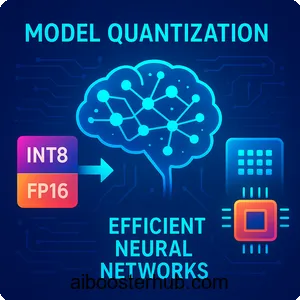
Model quantization is a model compression technique that reduces the precision of numerical representations used in neural networks. Instead of storing weights and activations as 32-bit floating-point numbers (FP32), quantization converts them to lower-precision formats like 16-bit floating-point (FP16) or 8-bit integers (INT8).
The mathematical foundation
At its core, quantization is a mapping function that converts high-precision values to low-precision representations. The quantization process can be expressed mathematically as:
$$x_q = \text{round}\left(\frac{x}{S}\right) – Z$$
Where:
- \(x\) is the original floating-point value
- \(x_q\) is the quantized integer value
- \(S\) is the scale factor
- \(Z\) is the zero-point offset
The dequantization process reverses this operation:
$$x = S \cdot (x_q + Z)$$
This simple mapping allows us to represent a continuous range of floating-point values using discrete integer values. The scale factor (S) determines the step size between quantized values, while the zero-point (Z) ensures that the value zero in the original representation maps exactly to an integer in the quantized representation.
Why quantization matters
The benefits of quantization extend beyond mere storage savings. Consider a typical deep learning model with 100 million parameters stored in FP32 format, requiring 400 MB of memory. By quantizing to INT8, the same model occupies only 100 MB—a 4× reduction. This compression translates directly to:
Reduced memory footprint: Smaller models fit on devices with limited memory, enabling deployment on mobile phones, IoT devices, and edge computing platforms.
Faster inference: Integer operations are significantly faster than floating-point operations on most hardware, particularly on specialized accelerators and mobile processors.
Lower bandwidth requirements: Reduced model size means faster download times and lower network costs for over-the-air model updates.
Energy efficiency: Integer arithmetic consumes less power than floating-point operations, crucial for battery-powered devices.
Precision levels in neural networks
Different precision levels offer varying trade-offs between accuracy and efficiency:
FP32 (Full Precision): The standard training precision, offering the highest accuracy with 32 bits per parameter. This format provides approximately 7 decimal digits of precision and a large dynamic range.
FP16 (Half Precision): Uses 16 bits per parameter, cutting memory requirements in half while maintaining reasonable accuracy for many applications. Modern GPUs include specialized hardware for FP16 operations, making them particularly efficient for both training and inference.
INT8 (8-bit Integer): The most common quantization target for inference, using only 8 bits per parameter. This represents a 4× reduction from FP32 and often maintains acceptable accuracy for deployed models.
Lower Precision: Emerging techniques explore INT4, INT2, and even binary neural networks, though these typically require more sophisticated quantization strategies to maintain accuracy.
2. Quantization deep learning: Strategies and approaches
Quantization isn’t a one-size-fits-all solution. Different strategies suit different deployment scenarios and accuracy requirements. Understanding these approaches helps you choose the right technique for your specific use case.
Symmetric vs. asymmetric quantization
Symmetric quantization assumes the quantized range is centered around zero, simplifying the quantization formula:
$$x_q = \text{round}\left(\frac{x}{S}\right)$$
Here, the zero-point (Z = 0), making the mapping simpler and more computationally efficient. Symmetric quantization works well when the distribution of values is roughly centered around zero, which is common after batch normalization.
Asymmetric quantization uses the full integer range by adjusting the zero-point:
$$x_q = \text{round}\left(\frac{x – x_{\min}}{S}\right)$$
Where \(S = \frac{x_{\max} – x_{\min}}{2^b – 1}\) and \(b\) is the bit width. This approach better handles distributions that are skewed or have a significant offset, common in activation functions like ReLU that produce only non-negative values.
Per-tensor vs. per-channel quantization
Per-tensor quantization uses a single scale factor for an entire tensor (weight matrix or activation). While computationally efficient, it may struggle with tensors containing values of vastly different magnitudes.
Per-channel quantization applies separate scale factors to each output channel of a convolutional or linear layer. For a weight tensor \(W\) with shape \([C_{\text{out}}, C_{\text{in}}, K_H, K_W]\), we compute:
for each output channel \(c\). This granular approach typically preserves accuracy better, especially in models where different channels operate at different scales, with only marginal computational overhead during inference.
Static vs. dynamic quantization
Static quantization determines scale factors and zero-points during a calibration phase before deployment. This requires a representative calibration dataset:
import torch
import torch.quantization as quantization

# Prepare model for static quantization
model.qconfig = quantization.get_default_qconfig('fbgemm')
model_prepared = quantization.prepare(model)

# Calibration phase
with torch.no_grad():
    for data, _ in calibration_loader:
        model_prepared(data)

# Convert to quantized model
model_quantized = quantization.convert(model_prepared)
Dynamic quantization computes scale factors on-the-fly during inference based on the observed range of activations. This approach is particularly useful for models with highly variable activation distributions:
# Dynamic quantization (simpler, no calibration needed)
model_dynamic = torch.quantization.quantize_dynamic(
    model,
    {torch.nn.Linear},
    dtype=torch.qint8
)
Dynamic quantization adds minimal computational overhead while providing flexibility for varying input distributions, making it ideal for natural language processing tasks where sequence lengths and content vary significantly.
3. Post-training quantization: Quick model compression
Post-training quantization (PTQ) is the most straightforward quantization approach, applied to an already-trained model without modifying the training process. This technique is ideal when you have a pre-trained model and want to deploy it quickly with reduced footprint.
The PTQ workflow
The post-training quantization process follows these steps:
Step 1: Calibration: Run representative data through the model to collect statistics about weight and activation distributions. This helps determine optimal scale factors and zero-points.
Step 2: Range estimation: Calculate the minimum and maximum values for weights and activations. Several methods exist for this:
- Min-Max: Uses the absolute minimum and maximum observed values
- Moving Average: Smooths out outliers by using exponential moving averages
- Percentile: Clips extreme values by using, for example, the 99th percentile
Step 3: Quantization: Convert the model’s weights and activations to the target precision using the computed scale factors.
Handling accuracy degradation
Post-training quantization can sometimes lead to accuracy loss, particularly for models with narrow activation distributions or highly sensitive layers. Several techniques mitigate this:
Layer-wise sensitivity analysis: Identify which layers are most affected by quantization by quantizing them individually and measuring accuracy impact. Sensitive layers can be kept in higher precision.
Bias correction: Adjust biases to compensate for quantization error in the preceding layer. The corrected bias can be computed as:
$$b_{\text{corrected}} = b + \mathbb{E}\left[(W – W_q) \cdot x\right]$$
Cross-layer equalization: Balance the range of weights across consecutive layers to make quantization more uniform. This involves absorbing scaling factors from one layer into adjacent layers without changing the overall function.
4. Quantization aware training: Maintaining accuracy
While post-training quantization is convenient, quantization aware training (QAT) typically achieves better accuracy by incorporating quantization effects during the training process itself. This allows the model to adapt to quantization constraints, learning weights that are more robust to precision reduction.
The QAT principle
Quantization aware training simulates quantization during forward passes while maintaining full precision gradients during backward passes. This is achieved through the “fake quantization” operator:
$$\tilde{x} = \text{dequant}(\text{quant}(x))$$
During the forward pass, this operator quantizes and immediately dequantizes values, introducing quantization noise that the model learns to accommodate. During the backward pass, we use the straight-through estimator to approximate the gradient:
$$\frac{\partial \tilde{x}}{\partial x} \approx 1$$
This approximation allows gradients to flow through the quantization operation despite its non-differentiable nature.
Fine-tuning strategies
Effective quantization aware training often requires careful hyperparameter tuning:
Learning rate: Use a lower learning rate than initial training, typically 1% to 10% of the original learning rate. This allows the model to adapt to quantization without making drastic changes.
Training duration: QAT typically requires fewer epochs than training from scratch—often 10% to 20% of the original training duration suffices.
Batch normalization: Freeze batch normalization statistics after a few epochs of QAT to stabilize quantization parameters. This can be done by switching to eval mode for batch norm layers:
# Freeze batch norm after epoch 2
if epoch >= 2:
    for module in model_prepared.modules():
        if isinstance(module, nn.BatchNorm2d):
            module.eval()
5. INT8 quantization: Industry standard for inference
INT8 quantization has emerged as the de facto standard for neural network inference optimization, offering an excellent balance between model size reduction, inference speed, and accuracy preservation. Most modern AI accelerators, from mobile processors to datacenter GPUs, include optimized INT8 execution units.
Why INT8 is the sweet spot
The dominance of INT8 quantization stems from several convergent factors:
Hardware support: Most processors include specialized INT8 arithmetic units that operate significantly faster than FP32 units. For instance, modern GPUs can perform INT8 operations at 4× to 16× the throughput of FP32 operations.
Accuracy preservation: Research and empirical evidence show that INT8 precision typically maintains model accuracy within 1-2% of FP32 for most computer vision and natural language processing tasks. The 256 discrete values provided by 8 bits prove sufficient for representing the distributions found in trained neural networks.
Memory bandwidth: In many inference scenarios, memory bandwidth rather than computation becomes the bottleneck. INT8 models transfer 4× less data between memory and compute units, directly translating to faster inference.
Quantization granularity for INT8
When implementing INT8 quantization, choosing the right granularity significantly impacts both accuracy and performance:
Per-tensor quantization uses a single scale factor for an entire weight matrix:
def quantize_tensor_symmetric(tensor, num_bits=8):
    """Symmetric per-tensor quantization to INT8"""
    max_val = torch.max(torch.abs(tensor))
    scale = max_val / (2 ** (num_bits - 1) - 1)

    quantized = torch.clamp(
        torch.round(tensor / scale),
        -(2 ** (num_bits - 1)),
        2 ** (num_bits - 1) - 1
    ).to(torch.int8)

    return quantized, scale

# Example usage
weight = torch.randn(64, 128)
quantized_weight, scale = quantize_tensor_symmetric(weight)
reconstructed = quantized_weight.float() * scale

error = torch.mean(torch.abs(weight - reconstructed))
print(f"Reconstruction error: {error:.6f}")
Optimizing INT8 inference
Beyond basic quantization, several optimizations enhance INT8 inference performance:
Operator fusion: Combine multiple operations into single kernels to reduce memory traffic. Common patterns include Conv-BatchNorm-ReLU fusion and Linear-ReLU fusion.
Mixed precision: Keep sensitive layers in FP16 or FP32 while quantizing the bulk of the model to INT8. This hybrid approach often achieves near-FP32 accuracy with minimal performance penalty:
# Example: Mixed precision quantization
def create_mixed_precision_model(model):
    """Keep first and last layers in FP32, quantize middle layers to INT8"""
    layers = list(model.modules())

    # Identify sensitive layers (first, last, batch norm)
    sensitive_layers = [layers[0], layers[-1]]
    sensitive_layers.extend([l for l in layers
                            if isinstance(l, nn.BatchNorm2d)])

    # Quantize non-sensitive layers
    for layer in layers:
        if layer not in sensitive_layers and hasattr(layer, 'weight'):
            layer.qconfig = quantization.get_default_qconfig('fbgemm')
        else:
            layer.qconfig = None

    return model
6. FP16 and other precision formats
While INT8 dominates inference optimization, FP16 quantization offers a different set of trade-offs, particularly valuable for training and certain inference scenarios. Understanding the broader landscape of precision formats helps you choose the optimal strategy for your specific use case.
FP16: Half precision floating point
FP16 uses 16 bits to represent floating-point numbers with 1 sign bit, 5 exponent bits, and 10 mantissa bits. This format provides:
Dynamic range: Values from approximately \(6 \times 10^{-8}\) to \(6.5 \times 10^{4}\), sufficient for most neural network operations.
Precision: About 3-4 decimal digits of precision, adequate for gradients and activations in most models.
Mixed precision training with FP16 has become standard practice, combining FP16 computation with FP32 master weights:
import torch
from torch.cuda.amp import autocast, GradScaler

# Initialize model and optimizer
model = ConvNet().cuda()
optimizer = torch.optim.Adam(model.parameters(), lr=0.001)

# Gradient scaler for mixed precision training
scaler = GradScaler()

for epoch in range(num_epochs):
    for data, target in train_loader:
        data, target = data.cuda(), target.cuda()

        optimizer.zero_grad()

        # Forward pass with autocast
        with autocast():
            output = model(data)
            loss = criterion(output, target)

        # Scaled backward pass
        scaler.scale(loss).backward()
        scaler.step(optimizer)
        scaler.update()
BFloat16: Brain floating point
BFloat16 (BF16) is an alternative 16-bit format with 1 sign bit, 8 exponent bits, and 7 mantissa bits. It trades precision for dynamic range:
Wider range: Same exponent range as FP32, making it more stable for training without requiring loss scaling.
Lower precision: Only 7 mantissa bits compared to FP16’s 10, but sufficient for neural network training.
BF16 has gained popularity in modern AI accelerators like Google’s TPUs and Intel’s processors:
# BFloat16 training (requires PyTorch 1.10+)
with torch.cuda.amp.autocast(dtype=torch.bfloat16):
    output = model(data)
    loss = criterion(output, target)
Advanced quantization techniques
Beyond standard formats, research continues to push quantization boundaries:
Mixed bit-width quantization: Different layers use different bit-widths based on sensitivity. For example, the first and last layers might use 16 bits while middle layers use 8 or even 4 bits.
Group quantization: Divide tensors into groups and apply per-group quantization, offering a middle ground between per-tensor and per-channel granularity.
Learned quantization: Use neural networks to learn optimal quantization parameters, including scale factors, zero points, and even bit allocations:
class LearnableQuantization(nn.Module):
    def __init__(self, num_bits=8):
        super().__init__()
        self.num_bits = num_bits
        # Learnable scale and zero point
        self.scale = nn.Parameter(torch.ones(1))
        self.zero_point = nn.Parameter(torch.zeros(1))

    def forward(self, x):
        # Apply learned quantization parameters
        scale = torch.abs(self.scale)  # Ensure positive scale
        quantized = torch.clamp(
            torch.round(x / scale - self.zero_point),
            0,
            2 ** self.num_bits - 1
        )
        # Dequantize
        output = (quantized + self.zero_point) * scale
        return output
ONNX quantization supports various optimization levels:
Dynamic quantization: Quantizes weights statically and activations dynamically.
Static quantization: Requires calibration data but achieves better performance.
Quantization-aware training export: Preserves QAT information for optimal inference.
7. Best practices and optimization strategies
Successfully deploying quantized models requires attention to numerous details beyond basic compression. This section distills practical wisdom from production deployments and research advances.
Calibration dataset selection
The calibration data used for post-training quantization critically impacts final model accuracy. Best practices include:
Representativeness: Choose calibration data that reflects the distribution of real-world inputs. Using 500-1000 diverse samples typically suffices.
Balancing: Ensure all classes or categories are represented proportionally in the calibration set to avoid bias toward overrepresented categories.
Augmentation: Apply the same preprocessing and augmentation used during training to calibration data.
def create_calibration_dataset(full_dataset, num_samples=1000):
    """Create a balanced calibration dataset"""
    from collections import defaultdict

    class_samples = defaultdict(list)

    # Group samples by class
    for idx, (data, label) in enumerate(full_dataset):
        class_samples[label].append(idx)

    # Sample proportionally from each class
    num_classes = len(class_samples)
    samples_per_class = num_samples // num_classes

    calibration_indices = []
    for class_idx, indices in class_samples.items():
        sampled = torch.randperm(len(indices))[:samples_per_class]
        calibration_indices.extend([indices[i] for i in sampled])

    return torch.utils.data.Subset(full_dataset, calibration_indices)
Layer-wise analysis and debugging
When quantization causes accuracy degradation, systematic layer-wise analysis identifies problematic layers:
def analyze_layer_sensitivity(model, test_loader, criterion):
    """Identify layers most sensitive to quantization"""
    results = {}

    # Get baseline accuracy
    baseline_acc = evaluate_model(model, test_loader)

    for name, module in model.named_modules():
        if not isinstance(module, (nn.Conv2d, nn.Linear)):
            continue

        # Temporarily quantize this layer
        original_weight = module.weight.data.clone()
        quantized_weight, scale = quantize_tensor_symmetric(original_weight)
        module.weight.data = quantized_weight.float() * scale

        # Measure accuracy impact
        acc = evaluate_model(model, test_loader)
        accuracy_drop = baseline_acc - acc

        results[name] = {
            'accuracy_drop': accuracy_drop,
            'weight_range': original_weight.abs().max().item(),
            'weight_std': original_weight.std().item()
        }

        # Restore original weights
        module.weight.data = original_weight

    # Sort by accuracy impact
    sorted_layers = sorted(results.items(),
                          key=lambda x: x[1]['accuracy_drop'],
                          reverse=True)

    print("Most sensitive layers:")
    for name, metrics in sorted_layers[:5]:
        print(f"{name}: {metrics['accuracy_drop']:.2%} accuracy drop")

    return results
Production deployment considerations
Deploying quantized models in production environments requires addressing several practical concerns:
Hardware compatibility: Verify that target hardware supports your chosen quantization scheme. Not all processors efficiently execute per-channel INT8 operations.
Inference framework: Different frameworks (TensorRT, ONNX Runtime, TensorFlow Lite) have varying quantization support and performance characteristics.
Fallback strategies: Implement graceful degradation by maintaining both quantized and full-precision versions, switching based on hardware capabilities or accuracy requirements.
8. Knowledge Check
Quiz 1: Quantization fundamentals
Question: What is the mathematical formula for quantizing a floating-point value to an integer representation, and what do the scale factor S and zero-point Z represent in this process?
Answer: The quantization formula is (x_q = \text{round}(x/S) – Z), where (x_q) is the quantized integer value, (x) is the original floating-point value, S is the scale factor that determines the step size between quantized values, and Z is the zero-point offset that ensures zero in the original representation maps exactly to an integer in the quantized representation.
Quiz 2: Precision formats comparison
Question: Compare the memory requirements and typical use cases for FP32, FP16, and INT8 precision formats in neural networks.
Answer: FP32 uses 32 bits per parameter and is the standard for training with highest accuracy. FP16 uses 16 bits, cutting memory in half while maintaining reasonable accuracy, commonly used in mixed precision training. INT8 uses 8 bits, providing 4× reduction from FP32, and has become the industry standard for inference optimization with specialized hardware support.
Quiz 3: Post-training quantization workflow
Question: Describe the three main steps involved in post-training quantization (PTQ) and explain why calibration data is necessary.
Answer: The three steps are: (1) Calibration – running representative data through the model to collect statistics, (2) Range estimation – calculating minimum and maximum values for weights and activations using methods like min-max or percentile, and (3) Quantization – converting the model to target precision using computed scale factors. Calibration data is necessary to determine optimal scale factors that minimize quantization error.
Quiz 4: Quantization aware training principles
Question: How does quantization aware training (QAT) differ from post-training quantization, and what is the “straight-through estimator” used in QAT?
Answer: QAT simulates quantization during training by using “fake quantization” operators that quantize and immediately dequantize values in forward passes, allowing the model to adapt to quantization constraints. The straight-through estimator approximates the gradient as (\partial\tilde{x}/\partial x \approx 1), allowing gradients to flow through the non-differentiable quantization operation during backpropagation.
Quiz 5: Symmetric vs asymmetric quantization
Question: What is the key difference between symmetric and asymmetric quantization, and when is each approach more appropriate?
Answer: Symmetric quantization assumes the quantized range is centered around zero with zero-point Z=0, making it computationally simpler and suitable for distributions centered around zero (common after batch normalization). Asymmetric quantization uses the full integer range with an adjustable zero-point, better handling skewed distributions like ReLU activations that produce only non-negative values.
Quiz 6: Per-channel quantization benefits
Question: Explain why per-channel quantization typically preserves accuracy better than per-tensor quantization, especially in convolutional layers.
Answer: Per-channel quantization applies separate scale factors to each output channel of a layer, allowing different channels to operate at different scales. This is beneficial because different channels in convolutional networks often have vastly different magnitude distributions. Per-tensor quantization uses a single scale factor for the entire tensor, which can lead to poor representation of channels with smaller magnitude values.
Quiz 7: INT8 hardware advantages
Question: Why has INT8 become the industry standard for neural network inference, and what specific advantages does it offer over FP32?
Answer: INT8 offers 4× memory reduction, significantly faster execution (4-16× throughput on modern GPUs), reduced memory bandwidth requirements (4× less data transfer), and lower power consumption. Most modern AI accelerators include specialized INT8 arithmetic units, and research shows INT8 typically maintains model accuracy within 1-2% of FP32 for most computer vision and NLP tasks.
Quiz 8: Mixed precision strategies
Question: What is a mixed precision quantization strategy, and why might you keep certain layers in higher precision?
Answer: Mixed precision keeps sensitive layers (typically first and last layers, or batch normalization layers) in FP16 or FP32 while quantizing the bulk of the model to INT8. This hybrid approach achieves near-FP32 accuracy with minimal performance penalty. Sensitive layers are identified through layer-wise sensitivity analysis, where layers that show significant accuracy drops when quantized are kept in higher precision.
Quiz 9: Calibration dataset selection
Question: What are the key characteristics of a good calibration dataset for post-training quantization, and approximately how many samples are typically needed?
Answer: A good calibration dataset should be representative of real-world input distributions, balanced across all classes or categories, and processed with the same preprocessing and augmentation used during training. Typically 500-1000 diverse samples suffice for effective calibration. The dataset should avoid bias toward overrepresented categories to ensure optimal quantization parameters for all use cases.
Quiz 10: ONNX quantization integration
Question: How does ONNX format facilitate cross-platform deployment of quantized models, and what types of quantization does it support?
Answer: ONNX provides standardized quantization support that enables deployment across different frameworks and hardware platforms. It supports dynamic quantization (quantizes weights statically and activations dynamically), static quantization (requires calibration data for better performance), and can preserve quantization-aware training information for optimal inference. This standardization allows models trained in PyTorch or TensorFlow to be deployed efficiently on various inference engines.