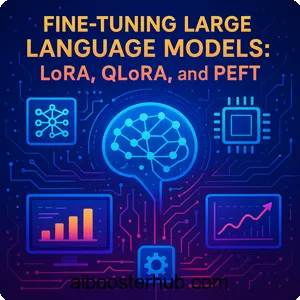
Fine-Tuning Large Language Models: LoRA, QLoRA, and PEFT
Large language models have revolutionized natural language processing, but adapting these massive models to specific tasks presents unique challenges. Traditional fine-tuning methods require substantial computational resources and storage, making them inaccessible to many researchers and practitioners. This comprehensive guide explores modern parameter efficient fine-tuning techniques that democratize LLM customization, focusing on LoRA, QLoRA, and the broader PEFT framework.
1. Understanding the challenge of fine tuning LLM
The computational bottleneck
Fine-tuning large language models traditionally involves updating all parameters in the network during training. For models like GPT-3 with 175 billion parameters or LLaMA-2 with 70 billion parameters, this approach demands enormous GPU memory and computational power. A full fine-tuning session might require multiple high-end GPUs running for days or weeks, consuming significant energy and financial resources.
The memory requirements scale linearly with model size. Each parameter needs storage for its value, gradient, and optimizer states (such as momentum and variance in Adam). For a single parameter stored in 32-bit floating point, you need approximately 16-20 bytes when accounting for all training states. This means a 7 billion parameter model requires roughly 120-140 GB of GPU memory just for the training process, excluding activation memory.
The catastrophic forgetting problem
When you fine-tune all parameters of a pretrained model on a specific task, the model tends to “forget” its original capabilities. This phenomenon, known as catastrophic forgetting, occurs because the parameters that encoded general knowledge get overwritten with task-specific patterns. The model might excel at your target task but lose its ability to perform other tasks it could handle before fine-tuning.
Storage and deployment challenges
Maintaining separate fully fine-tuned versions of large models for different tasks creates storage and deployment nightmares. If you need ten specialized versions of a 70B parameter model, you must store 700 billion parameters across all versions. This multiplication of storage requirements becomes impractical as you scale to more tasks or larger base models.
2. Parameter efficient fine-tuning fundamentals
Parameter efficient fine-tuning (PEFT) methods address these challenges by updating only a small subset of parameters while keeping the majority of the pretrained model frozen. This approach offers several advantages: reduced computational requirements, mitigation of catastrophic forgetting, and efficient multi-task deployment.
Core principles of PEFT
The fundamental insight behind PEFT is that the information needed to adapt a pretrained model to a new task has much lower dimensionality than the full parameter space. Rather than modifying all parameters, PEFT methods identify or create a small number of trainable parameters that can effectively capture task-specific adaptations.
Different PEFT approaches implement this principle in various ways. Adapter methods insert small neural network modules between transformer layers. Prefix tuning prepends trainable tokens to the input sequence. Prompt tuning learns soft prompts that condition the model’s behavior. Among these approaches, low-rank adaptation methods have emerged as particularly effective and practical.
Benefits over traditional fine-tuning
PEFT methods typically train only 0.1% to 10% of the original model’s parameters, dramatically reducing memory requirements and training time. A model that might require 140 GB for full fine-tuning could need only 10-20 GB with PEFT methods, making it feasible to train on consumer-grade GPUs.
Because the base model remains frozen, it retains its original capabilities while gaining new task-specific skills. Multiple PEFT modules can be stored alongside a single base model, enabling efficient multi-task deployment. Instead of storing ten complete 70B parameter models, you store one base model plus ten small adapter modules, each containing perhaps 100-500 million parameters.
3. LoRA: Low-rank adaptation of large language models
Low-Rank Adaptation (LoRA) represents one of the most successful PEFT techniques, offering an elegant solution to efficient fine-tuning through matrix decomposition. The method is based on the hypothesis that the updates needed during fine-tuning have low intrinsic rank.
The mathematical foundation
In standard fine-tuning, a weight matrix \( W \in \mathbb{R}^{d \times k} \) receives updates \( \Delta W \) during training, resulting in \( W’ = W + \Delta W \). LoRA constrains this update to be low-rank by decomposing it as:
$$ \Delta W = BA $$
where \( B \in \mathbb{R}^{d \times r} \) and \( A \in \mathbb{R}^{r \times k} \), with rank \( r \ll \min(d, k) \). The forward pass becomes:
$$ h = Wx + \frac{\alpha}{r}BAx $$
where \( \alpha \) is a scaling factor and \( r \) is the rank of the decomposition. During training, \( W \) remains frozen while only \( A \) and \( B \) are updated.
Implementation details
LoRA typically applies to the query and value projection matrices in attention layers, though you can extend it to other weight matrices. The rank \( r \) is a hyperparameter that controls the trade-off between expressiveness and efficiency. Common values range from 4 to 64, with higher ranks allowing more complex adaptations at the cost of more parameters.
The initialization of these matrices matters significantly. Matrix ( A ) is typically initialized with random Gaussian values, while ( B ) starts at zero. This ensures that at the beginning of training, \( \Delta W = 0 \), so the model starts with its pretrained behavior intact.
Practical implementation with HuggingFace
Here’s a practical example of implementing LoRA for fine-tuning a language model using the HuggingFace PEFT library:
from transformers import AutoModelForCausalLM, AutoTokenizer
from peft import get_peft_model, LoraConfig, TaskType
import torch

# Load pretrained model and tokenizer
model_name = "meta-llama/Llama-2-7b-hf"
model = AutoModelForCausalLM.from_pretrained(
    model_name,
    torch_dtype=torch.float16,
    device_map="auto"
)
tokenizer = AutoTokenizer.from_pretrained(model_name)

# Configure LoRA
lora_config = LoraConfig(
    r=16,  # rank of the update matrices
    lora_alpha=32,  # scaling factor
    target_modules=["q_proj", "v_proj"],  # which modules to apply LoRA
    lora_dropout=0.05,
    bias="none",
    task_type=TaskType.CAUSAL_LM
)

# Apply LoRA to the model
model = get_peft_model(model, lora_config)

# Check trainable parameters
model.print_trainable_parameters()
# Output: trainable params: 4,194,304 || all params: 6,742,609,920 || trainable%: 0.06%
This example shows how LoRA reduces trainable parameters to just 0.06% of the total, making fine-tuning dramatically more efficient. The target_modules parameter specifies which attention components receive LoRA adaptation. Experimenting with different modules can improve performance for specific tasks.
Choosing LoRA hyperparameters
The rank ( r ) is the most critical hyperparameter. Lower ranks (4-8) work well for simple adaptation tasks and minimize computational overhead. Higher ranks (32-64) provide more capacity for complex tasks but increase training time and memory usage. A good starting point is ( r = 8 ) or ( r = 16 ).
The scaling factor \( \alpha \) controls the magnitude of LoRA updates. A common practice is setting \( \alpha = 2r \), which empirically provides good stability. The ratio \( \alpha/r \) determines the learning rate scaling for LoRA parameters relative to the base learning rate.
4. QLoRA: Quantized low-rank adaptation
QLoRA extends LoRA by incorporating quantization, pushing efficiency even further. This technique enables fine-tuning of massive models on consumer hardware by reducing the memory footprint of the base model through 4-bit quantization while maintaining LoRA adapters in higher precision.
The quantization strategy
QLoRA introduces several innovations that make 4-bit quantization practical for fine-tuning. The key insight is that you can store the frozen base model in 4-bit precision while computing gradients through it, keeping only the LoRA adapters in full precision for training.
The method uses NormalFloat (NF4), a special 4-bit data type optimized for normally distributed weights. For a weight tensor with values following a normal distribution, NF4 provides better reconstruction quality than standard 4-bit integer quantization. The quantization maps floating-point values to 4-bit representations using:
$$ \text{NF4}(w) = \text{Quantize}(w, \text{bins}) $$
where the quantization bins are spaced to minimize expected quantization error for normal distributions.
Double quantization
QLoRA further reduces memory through double quantization, which quantizes the quantization constants themselves. When you quantize a tensor, you store scaling factors for each block of values. QLoRA quantizes these scaling factors from 32-bit to 8-bit, yielding additional memory savings without significant accuracy loss.
Paged optimizers
Memory spikes during training often come from optimizer states. QLoRA implements paged optimizers that use NVIDIA unified memory to automatically handle memory transfers between CPU and GPU RAM. This prevents out-of-memory errors during gradient computation for large models.
Implementing QLoRA
Here’s how to set up QLoRA for efficient fine-tuning:
from transformers import AutoModelForCausalLM, AutoTokenizer, BitsAndBytesConfig
from peft import prepare_model_for_kbit_training, LoraConfig, get_peft_model
import torch

# Configure 4-bit quantization
bnb_config = BitsAndBytesConfig(
    load_in_4bit=True,
    bnb_4bit_use_double_quant=True,  # double quantization
    bnb_4bit_quant_type="nf4",  # NormalFloat 4-bit
    bnb_4bit_compute_dtype=torch.bfloat16  # computation dtype
)

# Load model with quantization
model_name = "meta-llama/Llama-2-13b-hf"
model = AutoModelForCausalLM.from_pretrained(
    model_name,
    quantization_config=bnb_config,
    device_map="auto"
)
tokenizer = AutoTokenizer.from_pretrained(model_name)

# Prepare model for k-bit training
model = prepare_model_for_kbit_training(model)

# Configure LoRA
lora_config = LoraConfig(
    r=64,
    lora_alpha=128,
    target_modules=["q_proj", "k_proj", "v_proj", "o_proj"],
    lora_dropout=0.05,
    bias="none",
    task_type="CAUSAL_LM"
)

# Apply LoRA
model = get_peft_model(model, lora_config)
model.print_trainable_parameters()
# Output: trainable params: 33,554,432 || all params: 13,033,554,432 || trainable%: 0.26%
This configuration enables fine-tuning a 13 billion parameter model on a single 24GB GPU, which would be impossible with standard fine-tuning. The base model occupies roughly 6-7 GB in 4-bit precision, leaving ample room for LoRA parameters, activations, and optimizer states.
Memory savings analysis
Let’s compare memory requirements across different approaches for a 7B parameter model:
- Full fine-tuning (FP32): ~112 GB (16 bytes per parameter)
- Full fine-tuning (FP16): ~56 GB (8 bytes per parameter)
- LoRA (FP16): ~16-20 GB (base model + LoRA adapters)
- QLoRA (NF4): ~6-8 GB (quantized base + LoRA adapters)
QLoRA achieves nearly 20x memory reduction compared to full fine-tuning while maintaining comparable performance on downstream tasks.
5. The HuggingFace PEFT library ecosystem
The HuggingFace PEFT library provides a unified interface for various parameter efficient fine-tuning methods, making it easy to experiment with different approaches and integrate them into existing workflows.
Supported methods
Beyond LoRA and QLoRA, the PEFT library supports multiple adapter methods:
- LoRA and its variants: Standard LoRA, AdaLoRA (adaptive rank selection), QLoRA
- Prefix tuning: Prepends trainable prefix vectors to each transformer layer
- P-tuning: Learns continuous prompt embeddings
- Prompt tuning: Optimizes soft prompts prepended to inputs
- IA³ (Infused Adapter by Inhibiting and Amplifying Inner Activations): Scales activations with learned vectors
Unified training workflow
The PEFT library integrates seamlessly with HuggingFace Transformers and other training frameworks. Here’s a complete training example:
from transformers import AutoModelForCausalLM, TrainingArguments, Trainer
from peft import LoraConfig, get_peft_model
from datasets import load_dataset

# Load and prepare dataset
dataset = load_dataset("your_dataset")
tokenizer = AutoTokenizer.from_pretrained("meta-llama/Llama-2-7b-hf")

def tokenize_function(examples):
    return tokenizer(examples["text"], truncation=True, max_length=512)

tokenized_dataset = dataset.map(tokenize_function, batched=True)

# Setup model with LoRA
model = AutoModelForCausalLM.from_pretrained(
    "meta-llama/Llama-2-7b-hf",
    torch_dtype=torch.float16,
    device_map="auto"
)

lora_config = LoraConfig(
    r=16,
    lora_alpha=32,
    target_modules=["q_proj", "v_proj"],
    lora_dropout=0.05,
    bias="none",
    task_type="CAUSAL_LM"
)

model = get_peft_model(model, lora_config)

# Configure training
training_args = TrainingArguments(
    output_dir="./lora-llama-finetuned",
    per_device_train_batch_size=4,
    gradient_accumulation_steps=4,
    learning_rate=2e-4,
    num_train_epochs=3,
    logging_steps=10,
    save_strategy="epoch",
    fp16=True
)

# Train
trainer = Trainer(
    model=model,
    args=training_args,
    train_dataset=tokenized_dataset["train"],
    eval_dataset=tokenized_dataset["validation"]
)

trainer.train()

# Save only LoRA adapters
model.save_pretrained("./lora-adapters")
Loading and merging adapters
One of PEFT’s most powerful features is the ability to load different adapters for different tasks:
from peft import PeftModel

# Load base model
base_model = AutoModelForCausalLM.from_pretrained(
    "meta-llama/Llama-2-7b-hf",
    torch_dtype=torch.float16,
    device_map="auto"
)

# Load LoRA adapter for specific task
model = PeftModel.from_pretrained(
    base_model,
    "./lora-adapters-task1"
)

# Switch to different adapter
model.load_adapter("./lora-adapters-task2", adapter_name="task2")
model.set_adapter("task2")

# Or merge adapter weights into base model for deployment
merged_model = model.merge_and_unload()
merged_model.save_pretrained("./merged-model")
This flexibility enables efficient multi-task deployment where a single base model serves multiple specialized tasks by swapping lightweight adapters.
6. Best practices and practical considerations
Selecting the right approach
Choose your fine-tuning strategy based on available resources and task requirements:
- Full fine-tuning: When you have abundant compute resources and need maximum performance for a single critical task
- LoRA: When you need good performance with moderate memory constraints and want to maintain multiple task-specific models
- QLoRA: When working with consumer GPUs or need to fine-tune very large models (13B+ parameters) on limited hardware
Hyperparameter tuning strategies
Start with conservative hyperparameters and gradually increase complexity:
- Initial configuration: \( r = 8 \), \( \alpha = 16 \), learning rate = 2e-4
- If underfitting: Increase rank to 16 or 32, expand target modules to include all attention projections
- If overfitting: Reduce rank, increase dropout, decrease learning rate
- For complex tasks: Higher ranks (32-64) with more training data
The learning rate for LoRA fine-tuning is typically higher than full fine-tuning (2e-4 to 3e-4 vs 1e-5 to 5e-5) because you’re training fewer parameters from scratch-like initialization.
Data preparation
Quality matters more than quantity for parameter efficient fine-tuning. Since you’re adapting rather than retraining, focus on:
- Representative examples: Ensure your dataset covers the full range of behaviors you want to teach
- Clean data: Remove duplicates, correct errors, and maintain consistent formatting
- Balanced distribution: Avoid extreme class imbalances that might destabilize training
For instruction fine-tuning, a few thousand high-quality examples often suffice. Task-specific adaptation might need even less data, sometimes as few as hundreds of examples.
Evaluation and validation
Monitor both task-specific metrics and general capabilities:
from transformers import pipeline

# Create generation pipeline
generator = pipeline(
    "text-generation",
    model=model,
    tokenizer=tokenizer
)

# Test task-specific behavior
task_prompts = [
    "Analyze the sentiment: This movie was fantastic!",
    "Summarize: [long article text]"
]

# Test general capabilities
general_prompts = [
    "What is the capital of France?",
    "Explain photosynthesis simply."
]

for prompt in task_prompts + general_prompts:
    output = generator(prompt, max_length=100)
    print(f"Prompt: {prompt}\nResponse: {output[0]['generated_text']}\n")
This dual evaluation ensures your fine-tuned model excels at the target task without losing general knowledge.
Deployment considerations
For production deployment, consider merging LoRA weights into the base model to simplify inference:
# Merge and save for deployment
merged_model = model.merge_and_unload()
merged_model.save_pretrained("./production-model")
tokenizer.save_pretrained("./production-model")

# The merged model can be loaded as a standard model
from transformers import AutoModelForCausalLM
production_model = AutoModelForCausalLM.from_pretrained("./production-model")
Alternatively, keep adapters separate if you need to serve multiple specialized versions, loading different adapters based on user requests.
7. Conclusion
Parameter efficient fine-tuning methods have fundamentally transformed how we adapt large language models to specific tasks. LoRA and QLoRA in particular offer compelling solutions that make LLM fine tuning accessible to researchers and practitioners with limited computational resources. By training only a small fraction of parameters, these techniques achieve comparable performance to full fine-tuning while dramatically reducing memory requirements, training time, and storage costs.
The HuggingFace PEFT library ecosystem provides robust, production-ready implementations of these methods, with seamless integration into existing workflows. Whether you’re fine-tuning a 7B parameter model on consumer hardware with QLoRA or managing multiple specialized adapters with LoRA, these tools democratize access to cutting-edge AI capabilities. As large language models continue to grow in size and capability, parameter efficient fine-tuning will remain essential for practical deployment and customization across diverse applications.
8. Knowledge Check
Quiz 1: Challenges of Traditional Fine-Tuning
Quiz 2: Fundamentals of PEFT
Quiz 3: The Mathematical Foundation of LoRA
Quiz 4: LoRA Hyperparameter Tuning
r) and the scaling factor (α). The rank r controls the number of trainable parameters and the expressiveness of the adaptation, with common values ranging from 4 to 64. The scaling factor α controls the magnitude of the LoRA updates, and a common practice is to set α = 2r to provide good stability.